
At the border between Barkam County (马尔康市 · འབར་ཁམས་གྲོང་ཁྱེར།) and Jinchuan County (金川县 · ཆུ་ཆེན་རྫོང་།) in Ngawa Prefecture (阿坝州 · རྔ་བ་ཁུལ།), Sichuan (四川)—along the upper reaches of the Dadu River valley, a concrete dam is severing the river’s flow, impounding its waters into a vast reservoir. It carries a grand-sounding name: the Shuangjiangkou (literally “the place where two rivers meet”) hydropower station. Looking upstream along the reservoir’s shoreline, one encounters two events that seem entirely unrelated, yet are stitched tightly together by this dam:
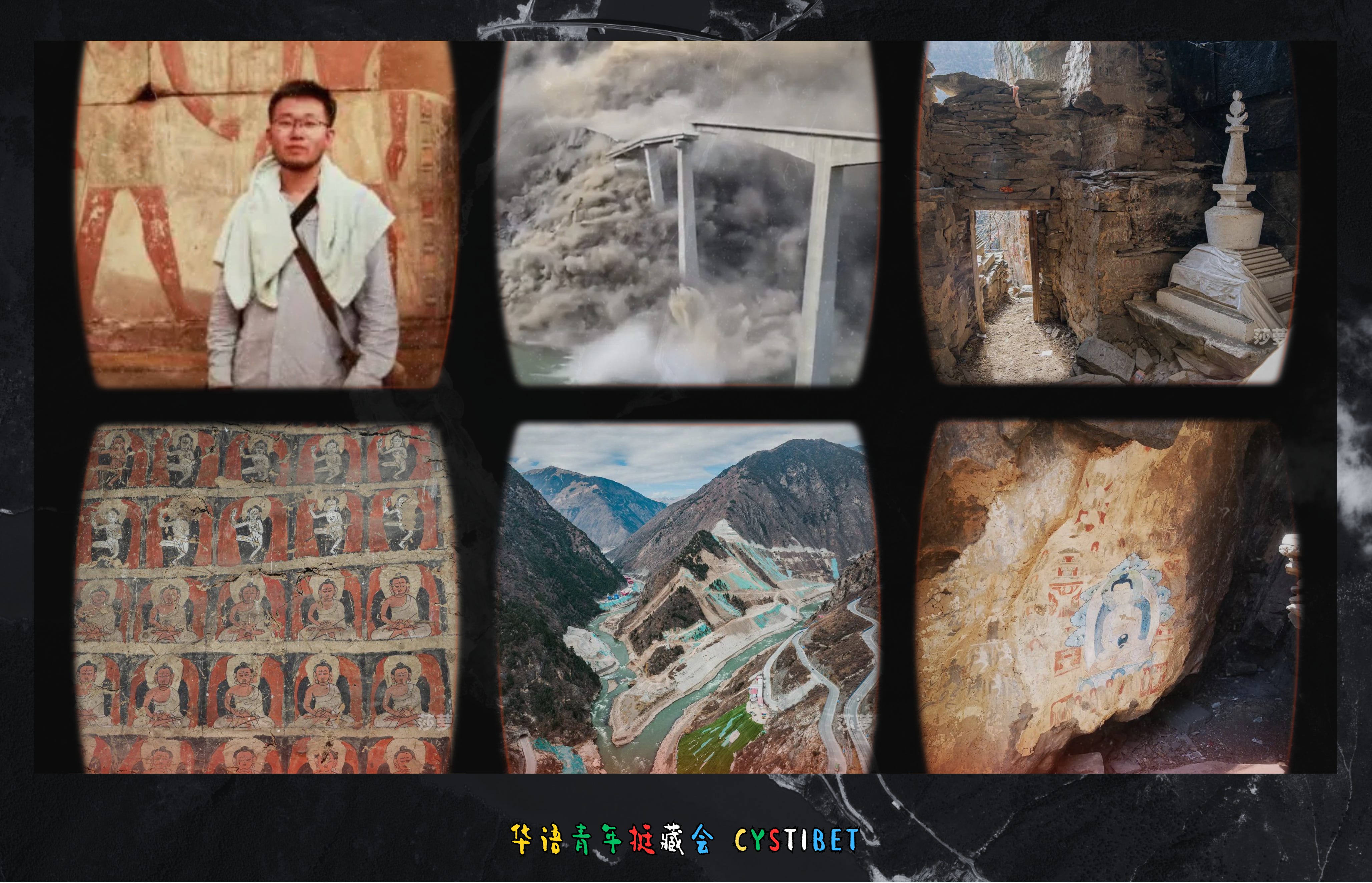
One occurred on November 11, 2025, when a landslide caused the Hongqi (literally “the Red Flag”) Bridge—completed less than a year prior—to collapse with a thunderous roar into the canyon.
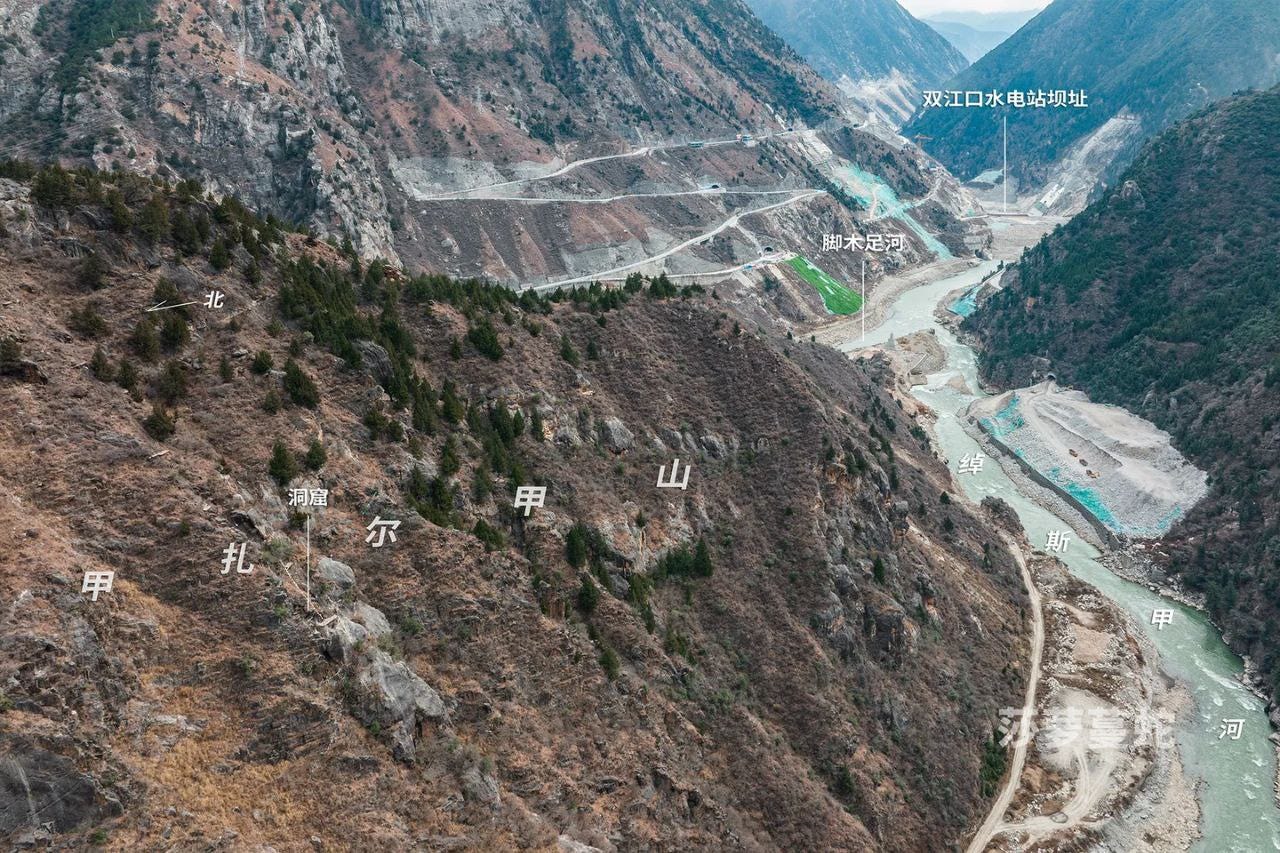
The other took place just 1.7 km away, in the autumn of 2021: the young archaeologist Liu Tuo fell to his death while making a final record of Tibetan Buddhist murals in the Jiazha’erjia Mountain cave site, which was about to be inundated by the reservoir.
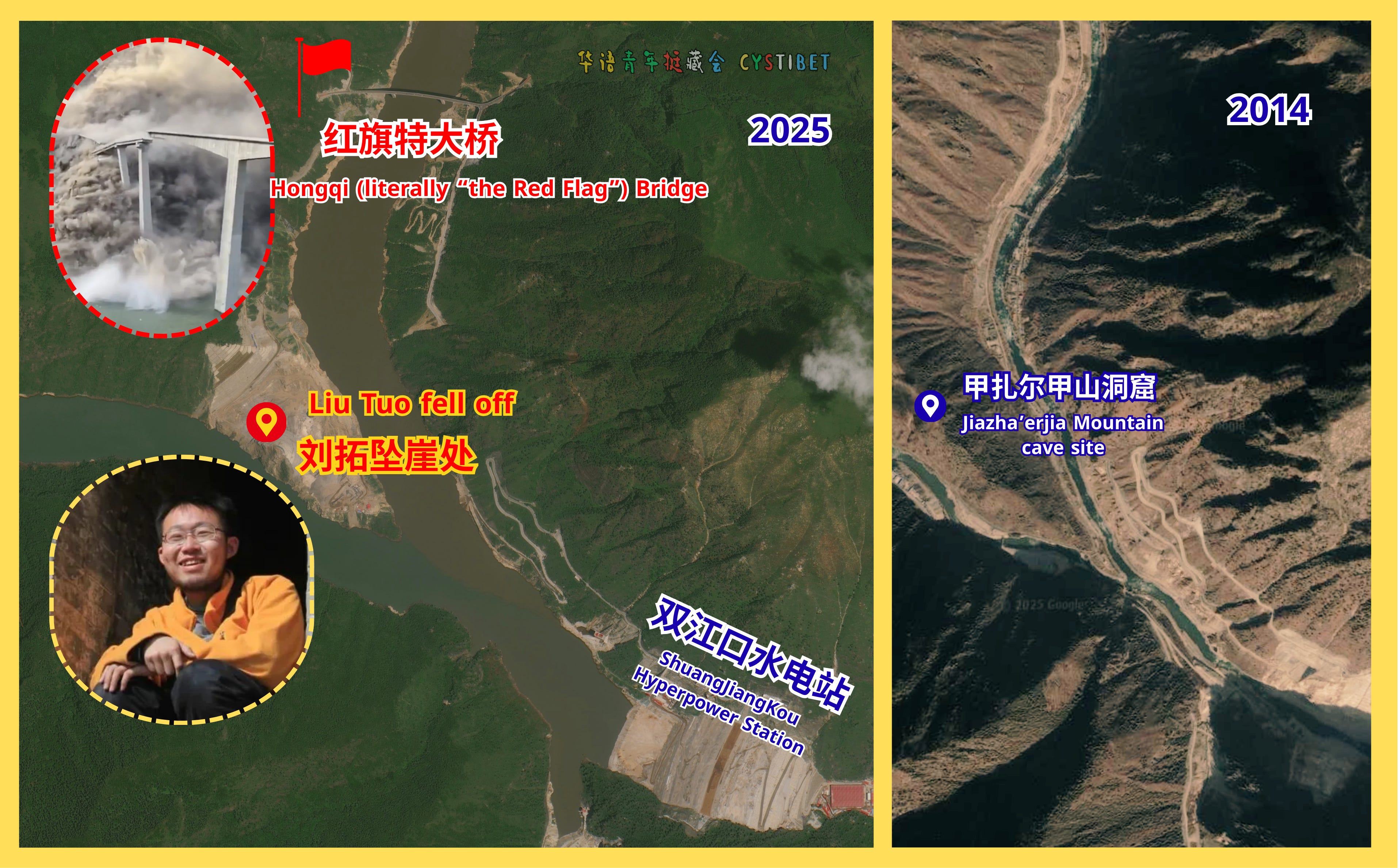
(Left: A satellite image from May 2025 after the first phase of water impoundment at the Shuangjiangkou Hydropower Station. The completed dam at the bottom right has severed the river. The Hongqi Grand Bridge (31.821°N, 101.907°E) at the top has not yet collapsed. Mount Jiazha’erjia (31.806°N, 101.902°E), where Liu Tuo fell, has been partially leveled. The water level has risen significantly, widening the river and submerging everything below the mountainside. Right: A satellite image from 2014 before construction, showing Mount Jiazha’erjia intact and the original landscape.)
One was the deafening roar of a recent disaster site; the other, the low echo of a young scholar falling to the canyon floor. Looking back now, the collapse of the Hongqi Bridge does not appear to be an isolated catastrophe. Rather, it feels like an echo of Liu Tuo’s death reverberating through the valley. They are linked by an invisible thread: a chain reaction of extractive development carried out in the name of “development.” Mountains can be blasted, rivers can be dammed, and the villages, sacred sites, culture, and memories of the Tibetan people are all treated as disposable costs for the sake of economic progress.
More than an Engineering Accident
The Hongqi Bridge on National Highway 317 was once promoted as a “Lifeline in the Clouds.” In official footage, it spanned the gorge with piers soaring into the mist against a backdrop of majestic peaks—hailed as a “green road for ecological protection” and a “path of unity for ethnic solidarity.”

(The “Bridge in the Clouds” under construction from the official perspective. Source: Sichuan Road & Bridge Corporation, January 2025.)
However, at approximately 4:00 PM on November 11, 2025, a landslide struck the right-bank abutment of the bridge. Sections of the structure fractured and gave way. The bridge deck, along with its massive piers, smashed into the valley, sending plumes of dust exploding along the riverbank. In videos of the event, a voice cries out in bewilderment: “The bridge is gone!” It had been open to traffic for less than ten months.
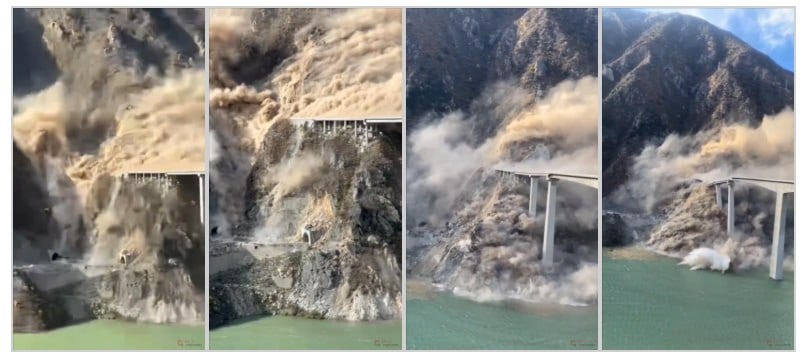
(Video screenshot of the collapse. Source: China National Radio.)
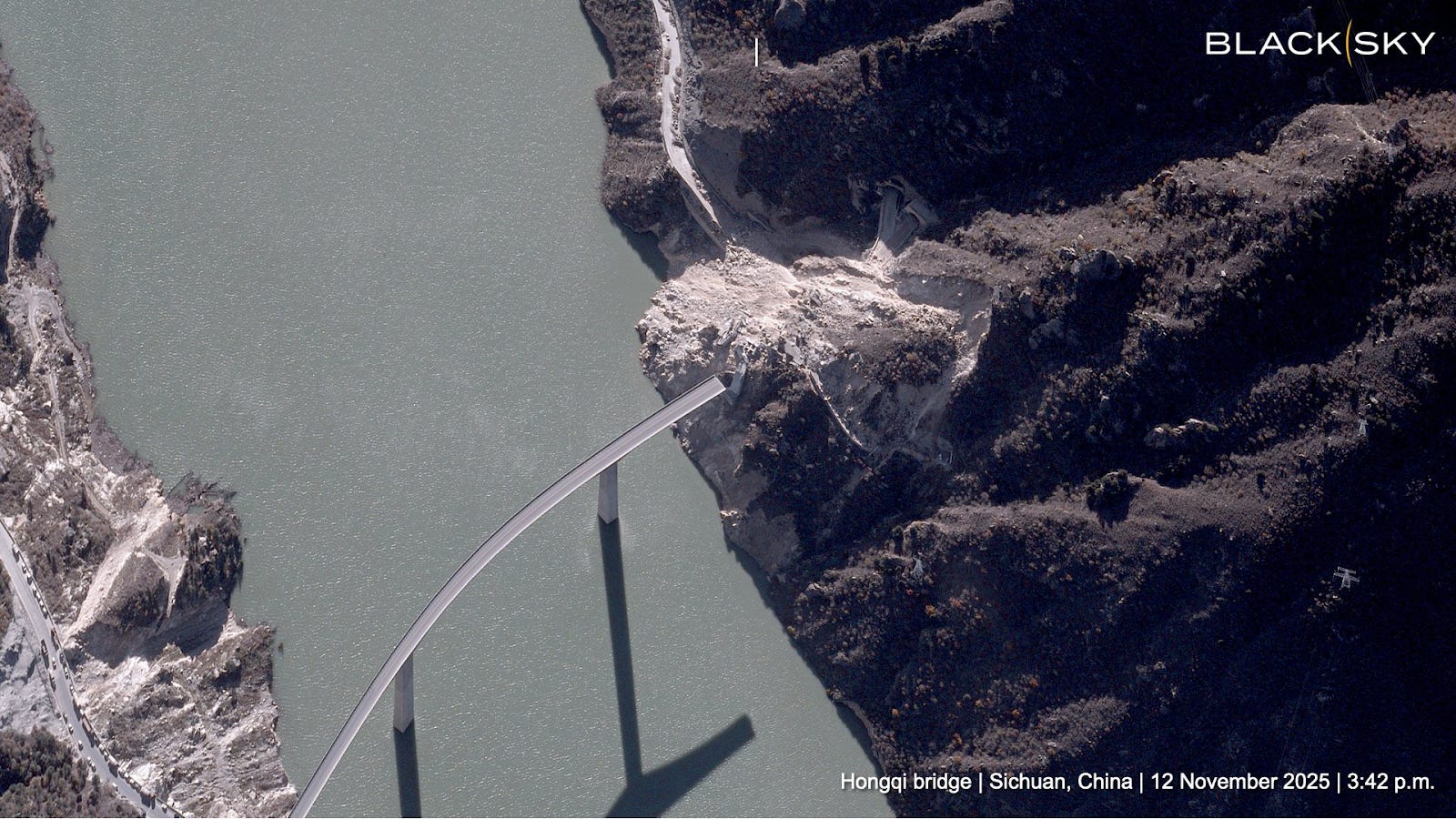
(Satellite image of the bridge after collapse. Source: BlackSky.)
This time, news reports repeatedly emphasized that there were “no casualties.” This was because a Tibetan driver named Tsering Si Tenzin (reported only under the Chinese rendering 三郎石旦真) had spotted cracks the previous day, leading to an emergency closure and the redirection of vehicles. Numerically, it was indeed “lucky”—as if, so long as no one died, everyone could breathe a sigh of relief.
But if we look further back, it becomes clear that this was more than a mere engineering accident.
On May 1, 2025, Shuangjiangkou completed Phase I impoundment, raising the water level to 2,344.3 meters above sea level, with a depth increase of more than 90 meters and a storage volume of 110 million cubic meters. On October 10, 2025, Phase II impoundment began, with the water level rising by more than 70 meters and storage reaching 660 million cubic meters. Within approximately seven months, the water level rose by more than 160 meters. This rate and magnitude of rising water set a world record. Just one month after Phase II began, the Hongqi Bridge, located in the heart of the reservoir area, collapsed.
The Shuangjiangkou station is situated in a high-altitude region with intense erosion and extremely complex geological structures. The Dadu River carves through deep canyons often exceeding 1,000 meters in depth. The geological environment was inherently unstable. Local villagers noted that once the water began to rise, landslides became frequent; the slope behind their old village collapsed after the first phase of impoundment. A reservoir exerts immense weight; such rapid and massive water accumulation easily triggers landslides and collapses—phenomena frequently observed in other large-scale reservoirs such as the Three Gorges.
Following the collapse, officials stated they would organize experts for on-site verification and establish a special task force. Since then, there has been little follow-up. Most reporting on the bridge stopped there. The Tibetans who actually live in this valley appeared only as background figures or blurred “relocated villagers.”


(For the Shuangjiangkou project, the Jinchuan County government demolished Tibetan homes; prayer flags flutter over the rubble. Official media captured these photos to showcase the “resolute action” of leaders in “creating favorable conditions for construction.” Source: Jinchuan County Government Website.)
In early feasibility studies, one official “challenge” was the need to relocate around 6,000 “Tibetan-area resettlers,” alongside “prominent ethnic and religious issues.” Given the local demographics, the vast majority of those forced to leave were Tibetan. In another official report on the western route of the South-to-North Water Diversion Project, Shuangjiangkou—treated as part of a water-source reservoir system—is brushed into a single sentence claiming that “Challenges such as migrants in the submerged area and the handling of religious facilities have been basically resolved.” It was as if entire communities and sacred spaces between mountains and rivers were merely checkboxes on a to-do list..
In a report by The Paper, a villager from Ying’geluo Village in Baiwan Township says something few people notice: their old village used to be by the river, but after impoundment, the old houses collapsed into the water. They now live in a temporary prefab resettlement site along the reservoir. “I just went back to the prefab village a week ago,” he said. “Now that the bridge is down, we can’t go back again.” In the news, this is only a passing detail, but for him, it is the second time he “can’t go back”: first, the water swallowed the old village; second, the bridge built for this very reservoir collapsed, cutting off even the new resettlement site across the river.
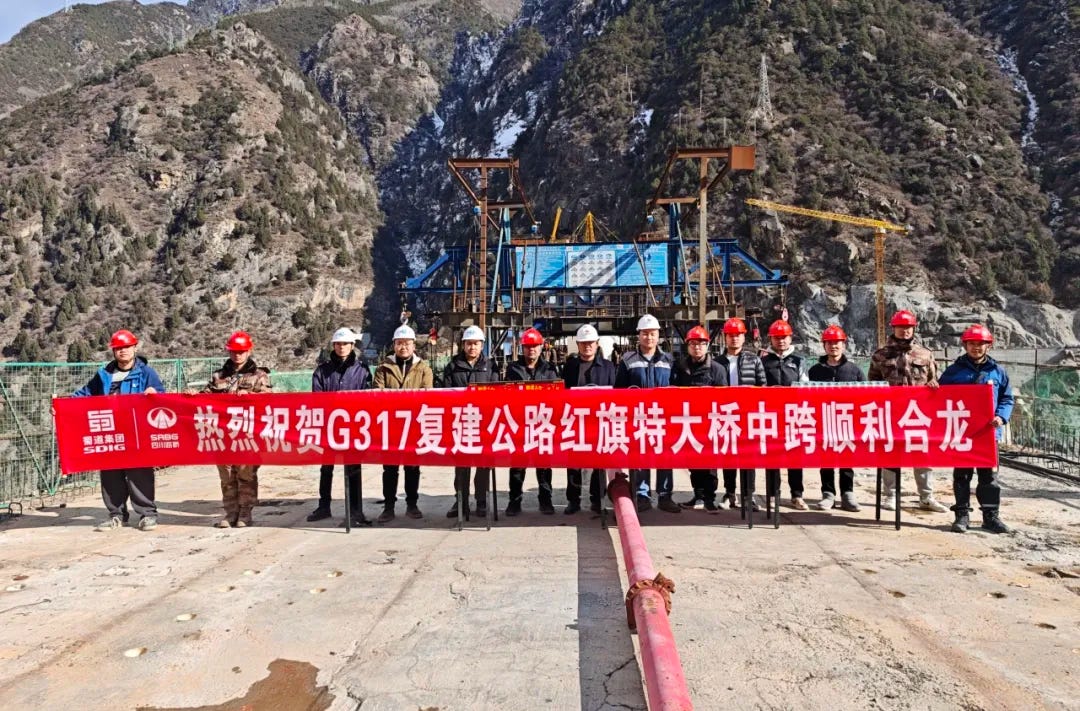
(Sichuan Road & Bridge Corporation, January 2025:The scene of the closing ceremony of the Hongqi Extra-Large Bridge.)
In the engineering system, he is just a digit among 6,000 migrants. In the news, he is simply “a villager interviewed.” In planning documents and official prose, he and thousands like him—families rooted here for generations—are summarized as “obstacles” to construction. But for each Tibetan like him, every “bang” in this valley—the damming of the river, the relocation of caves, the demolition of villages, the collapse of bridges—rewrites the roads beneath their feet, the mountains above their heads, and whether they can still return to the place their ancestors called home.
These stories never appear in the mainstream narrative, and they are never told through the lens of Tibetan identity.
In this valley of constant upheaval, there is one more person who cannot go back. He was not on the list of migrants, but he chose to use his footsteps and his camera to guard the caves and stupas destined to be submerged or razed. Four years ago, while recording Tibetan Buddhist mural caves, a young archeologist fell from a cliff two kilometers from the dam. His death was a crack in the valley’s lifeline; the collapse of the bridge is the echo passing through that crack.
Another Road That Ends at the Cliff: The Death of Liu Tuo
Turn back four years to Jiazha’erjia Mountain in Barkam County (马尔康市 · འབར་ཁམས་གྲོང་ཁྱེར།), Ngawa Prefecture(阿坝州 · རྔ་བ་ཁུལ།), Sichuan. On October 26, 2021, Liu Tuo, a PhD from Peking University’s School of Archaeology and Museology, died in an accident while surveying cultural relics slated for “off-site protection” (relocation). He was only 31. His friends later found the last photo on his camera: a “National Treasure” mural inside the Jiazha’erjia caves.


(The last photos of Liu Tuo before his death; at that time, the vegetation in Jiazha’erjia was still lush. 2021.10.26)
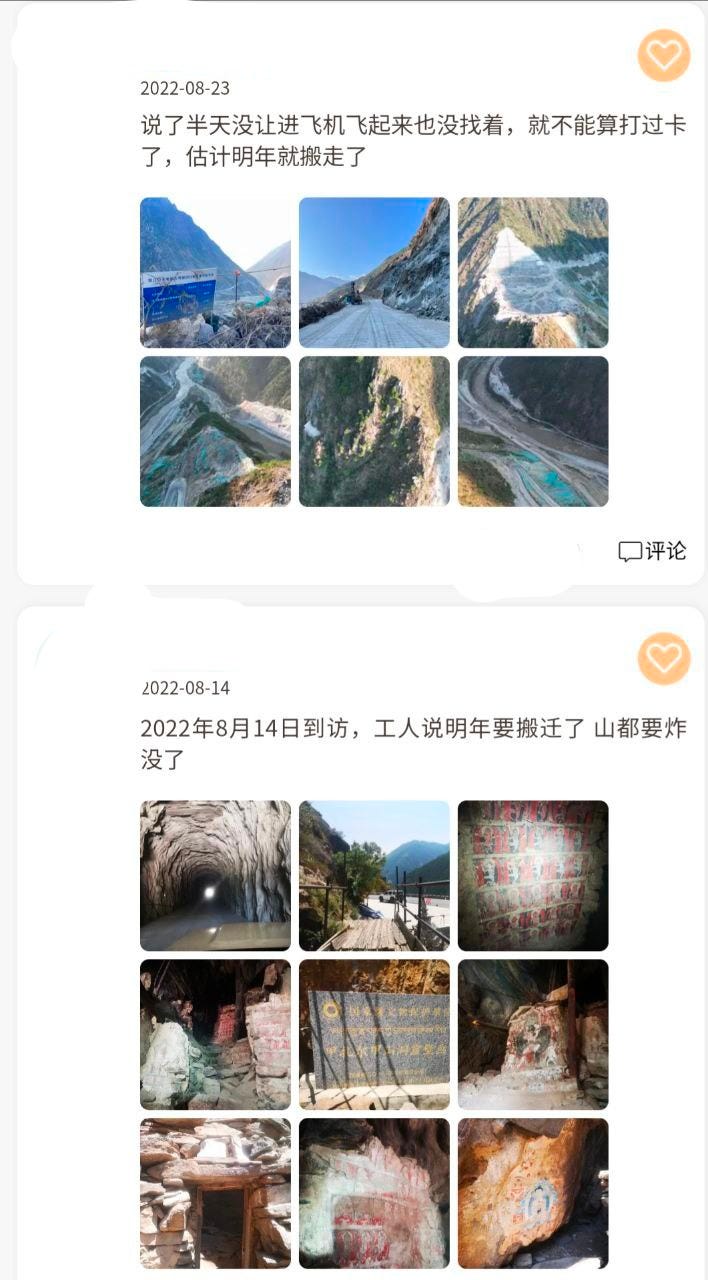
It is a mountain whose name most people wouldn’t recognize, yet its caves held 14th and 15th-century Tibetan Buddhist murals and stupas. After the Shuangjiangkou hyperpower project was approved and construction advanced, the area was designated for submersion, and the Jiazha’erjia caves were included in a 2018 plan for relocation and off-site preservation.
Relocation, off-site, preservation—these words sound reassuring. In practice, they mean the original cave site will be submerged or destroyed, and the only option is to cut murals from the rock walls and move them elsewhere. The mountain no longer matters; the sacred geography no longer matters. What matters is that the “cultural relic” is “preserved” in a climate-controlled hall for display.
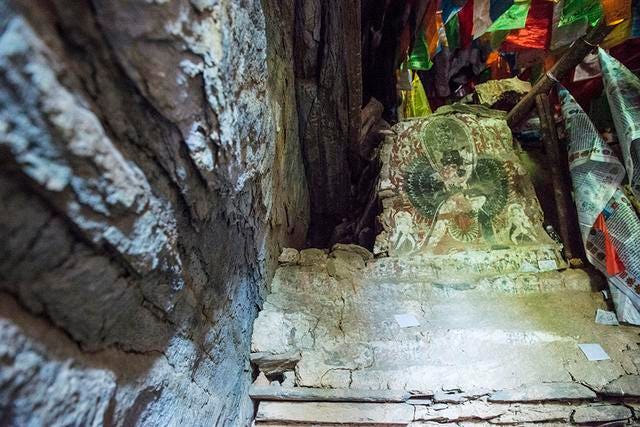
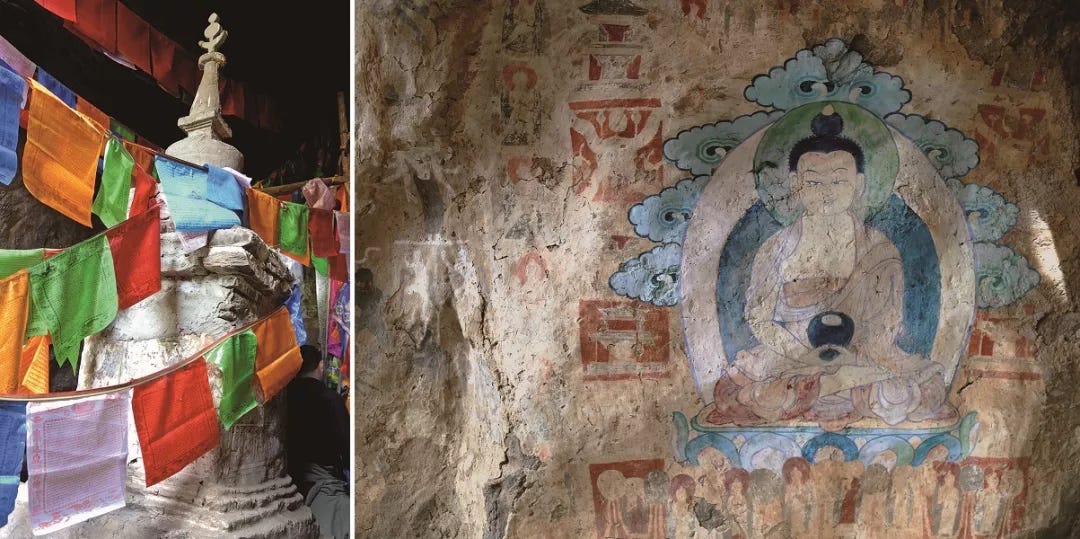
(Photo of the murals in their original location in the Jiazha’erjia Caves)
At the original site, the rock walls are so coarse that they seem to retain the mountain’s first breath. There is but a single step between the devotee and the Buddha. Prayer flags—old and new—flutter above the stupas, layered one upon another. They are evidence of those who came before and those who continue to come. This is not an exhibit sealed behind glass and placards; it is a shrine still bowed to in devotion. The incense had never stopped burning; the offerings never ceased. The Buddha’s statues and murals stand as living presences—gods who listened to prayers and protected all beings.
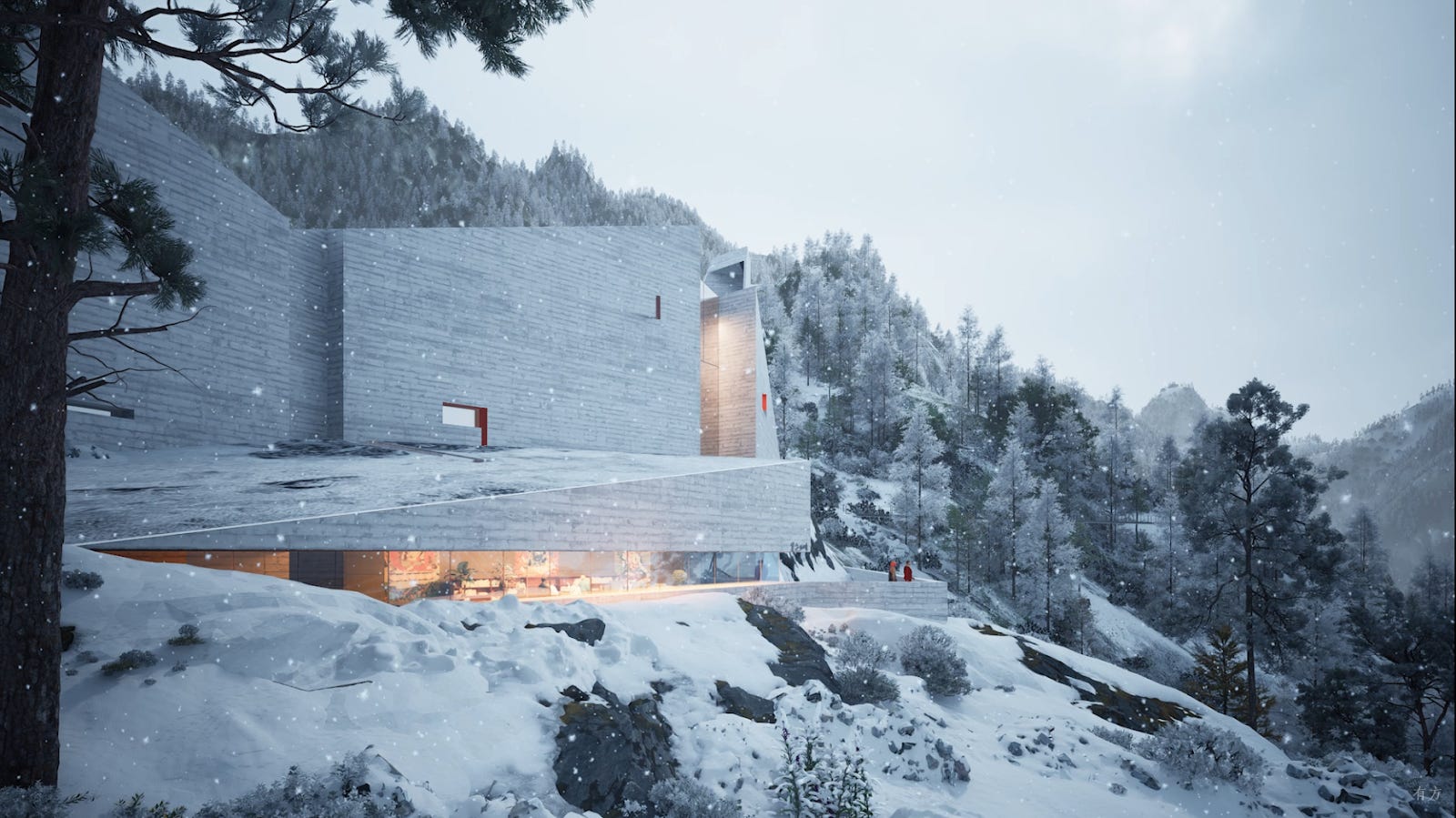
(Rendering of the new museum for the Jiazha’erjia murals)
The new museum, built for “off-site preservation,” however, looks like a giant concrete wedge driven into the hillside. With its cool-toned façade, sharp angles, and expansive glass curtain walls, it looks in the snow like a contemporary art museum that could appear anywhere. It almost entirely erases Tibetan architectural language: no stupas, no kora (circumambulation) path, no mani stones. Even if prayer flags appear, they are reduced to decorative landscaping. The Buddhas and murals, once embedded in the living rock, are now specimens in climate-controlled cases—an “exotic spectacle” for consumption. For Tibetans, the original caves are a sacred place of encounter with the divine; the new museum is more like a carefully arranged glass display window, where visitors can safely admire a “Tibetan artifact” stripped from its land and rendered as a specimen.


(Exterior view and antechamber of the original site of the Jiazhaljia Mountain Caves (photographed by 莎萝蔓蛇 in December 2021) In Figure 5, the green circle indicates the location of the cave. Figure 6 shows a photo taken by a netizen in 2023, where the cave entrance has been sealed with cement. This area was submerged after the Shuangjiangkou Reservoir was filled with water :(
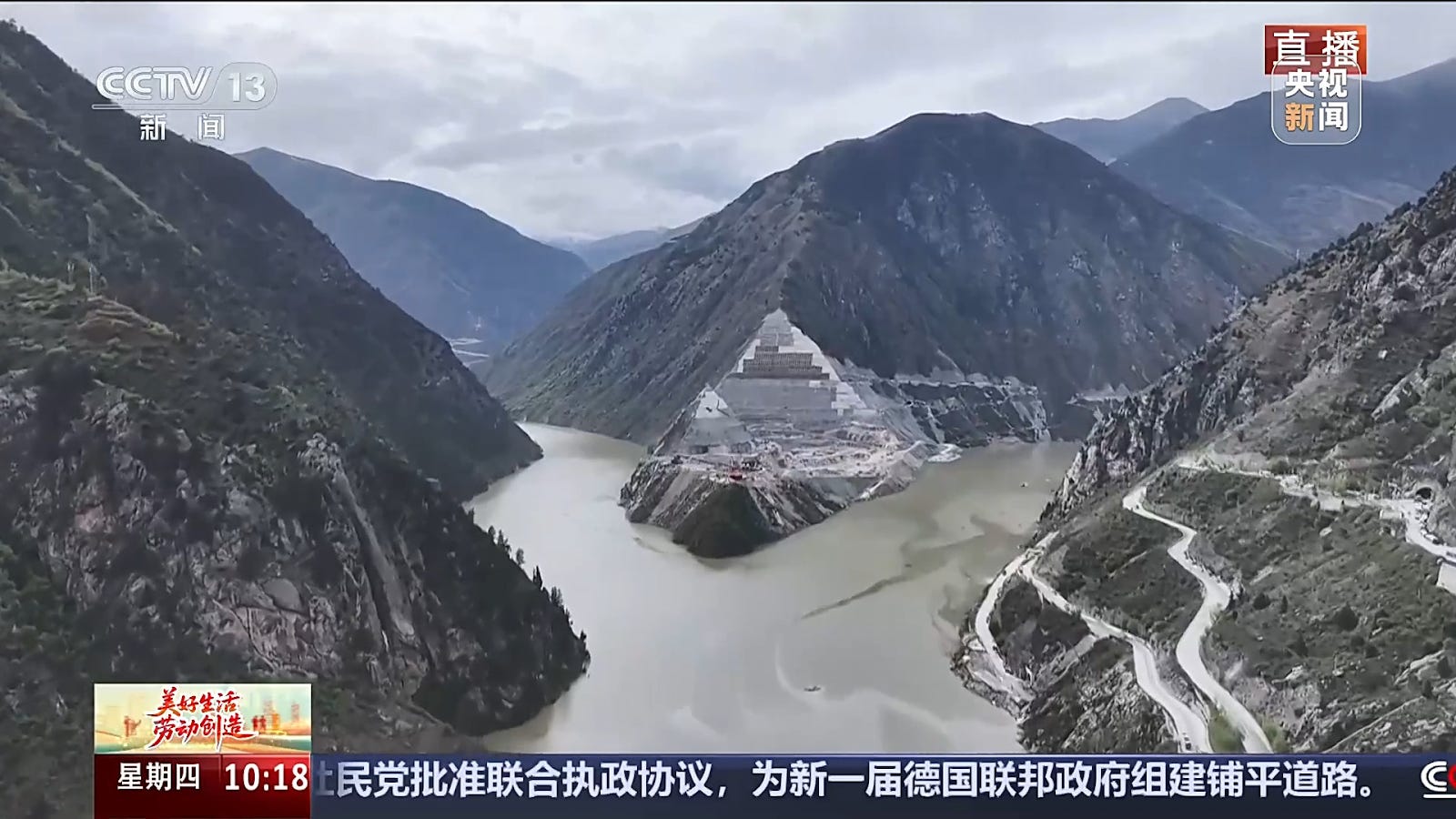
(CCTV footage showing the Shuangjiangkou reservoir after Phase I of impoundment. Mount Jiazha’erjia is in the center; part of the ridge has been leveled for construction, and the lower half is submerged.)
Liu Tuo wanted to see and record these murals and stupas one last time as they were—bound to the mountain and the divine—before they were sliced, numbered, and boxed. That is why, before the reservoir filled and the murals moved, he chose to shoulder his camera and take the perilous mountain path.
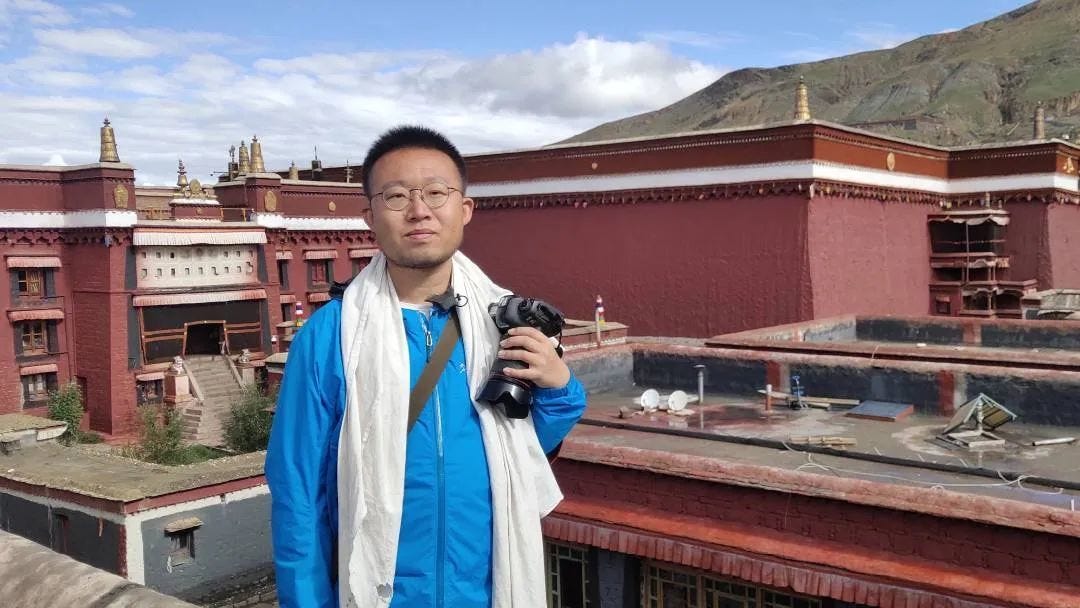
According to reports, on the evening of October 26, 2021, Liu Tuo traveled with three others to the Jiazha’erjia caves. Three turned back because the route was too dangerous, leaving Liu to continue alone. While climbing the rock face, he fell. Around 8:40 p.m. on October 26, a bystander called the police; rescuers found him severely injured and unconscious. Despite rescue efforts, he died at age 31.
Liu Tuo, a PhD graduate of Peking University’s archaeology program, was known by many as a “roving scholar.” Over more than a decade, he traveled through over thirty countries and countless remote valleys, documenting hundreds of heritage sites and leaving behind tens of thousands of photos, videos, and notes. His images often captured mosques on the edge of war zones, solitary steles in farm fields, and ancient cities about to be swallowed by reservoirs.
He could have stayed within a safe, approved identity: speaking only of archaeology and never of politics; singing praises of “forging a sense of community for the Chinese nation“ in papers and lectures, carefully avoiding sensitive history. But he did not. He wrote “incorrect” sentences, stating plainly that the CCP’s destructive damage to Tibetan culture was comparable to the Taliban and ISIS, and that the myth of “liberating serfs” concealed the CCP’s destruction of Tibetan civilization.
His final trip was to Jiazha’erjia Mountain. As the hyperpower project timetable pressed forward, he knew time was short. He had to document as much as possible before the murals were cut out and moved away. He never returned. The person who pressed the shutter and what he sought to preserve were written together into the fate of this valley.


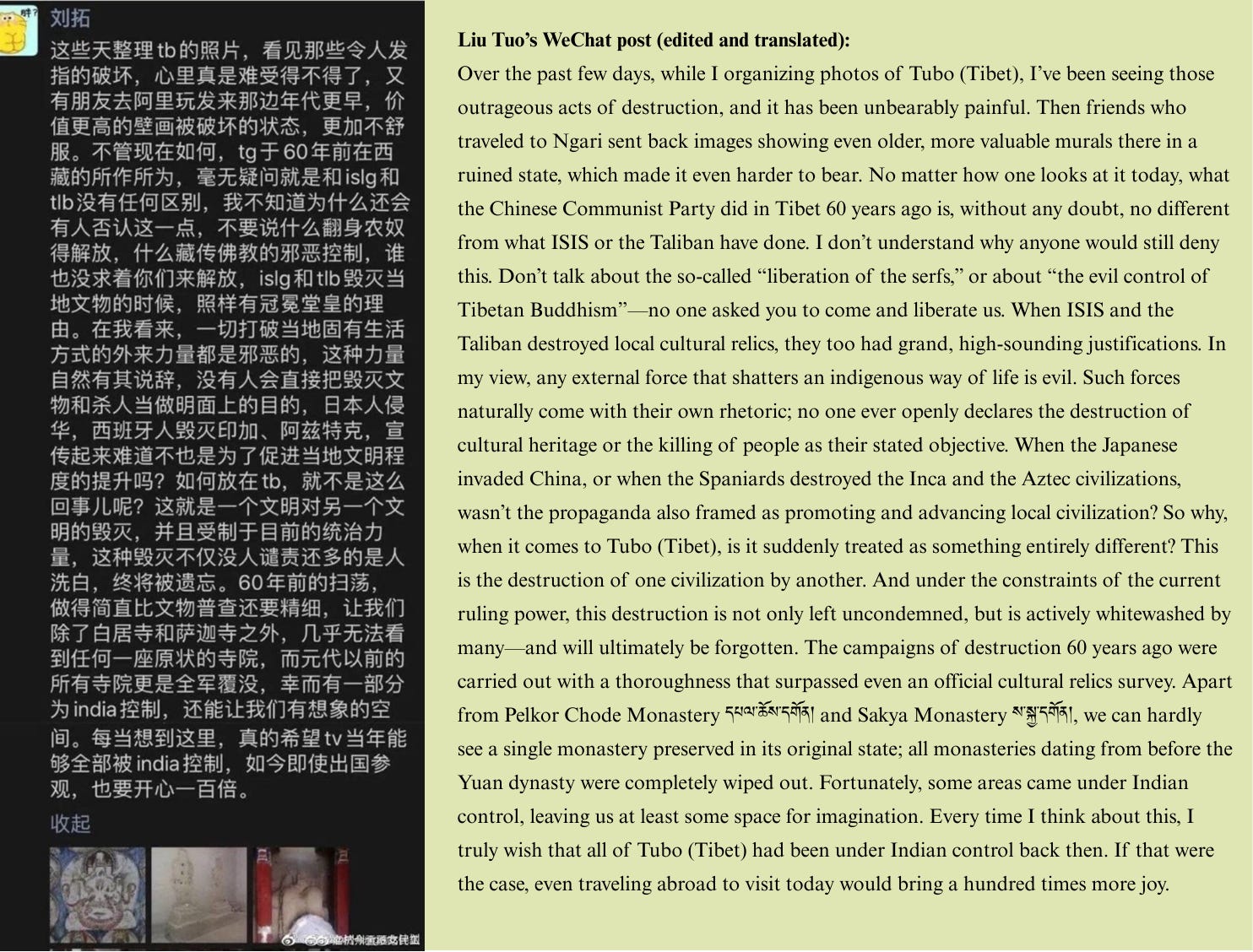
(Before and after Liu Tuo’s death , screenshots of his past WeChat posts circulated, triggering attacks by Chinese nationalists.)
Liu Tuo’s WeChat post (edited and translated):
Over the past few days, while I organizing photos of Tubo (Tibet), I’ve been seeing those outrageous acts of destruction, and it has been unbearably painful. Then friends who traveled to Ngari sent back images showing even older, more valuable murals there in a ruined state, which made it even harder to bear. No matter how one looks at it today, what the Chinese Communist Party did in Tibet sixty years ago is, without any doubt, no different from what ISIS or the Taliban have done. I don’t understand why anyone would still deny this. Don’t talk about the so-called “liberation of the serfs,” or about “the evil control of Tibetan Buddhism”—no one asked you to come and liberate us. When ISIS and the Taliban destroyed local cultural relics, they too had grand, high-sounding justifications. In my view, any external force that shatters an indigenous way of life is evil. Such forces naturally come with their own rhetoric; no one ever openly declares the destruction of cultural heritage or the killing of people as their stated objective. When the Japanese invaded China, or when the Spaniards destroyed the Inca and the Aztec civilizations, wasn’t the propaganda also framed as promoting and advancing local civilization? So why, when it comes to Tubo (Tibet), is it suddenly treated as something entirely different? This is the destruction of one civilization by another. And under the constraints of the current ruling power, this destruction is not only left uncondemned, but is actively whitewashed by many—and will ultimately be forgotten. The campaigns of destruction sixty years ago were carried out with a thoroughness that surpassed even an official cultural relics survey. Apart from Gyantse’s Pelkor Chöde and Sakya Monastery, we can hardly see a single monastery preserved in its original state; all monasteries dating from before the Yuan dynasty were completely wiped out.
Fortunately, some areas came under Indian control, leaving us at least some space for imagination. Every time I think about this, I truly wish that all of Tubo (Tibet) had been under Indian control back then. If that were the case, even traveling abroad to visit today would bring a hundred times more joy.
In the Name of “Development”
Along the Dadu River, you see layers of engineering vocabulary stamped onto the land: “Cascade Development,” “World’s Highest Dam,” “Integrated Water-Wind-Solar Power.”
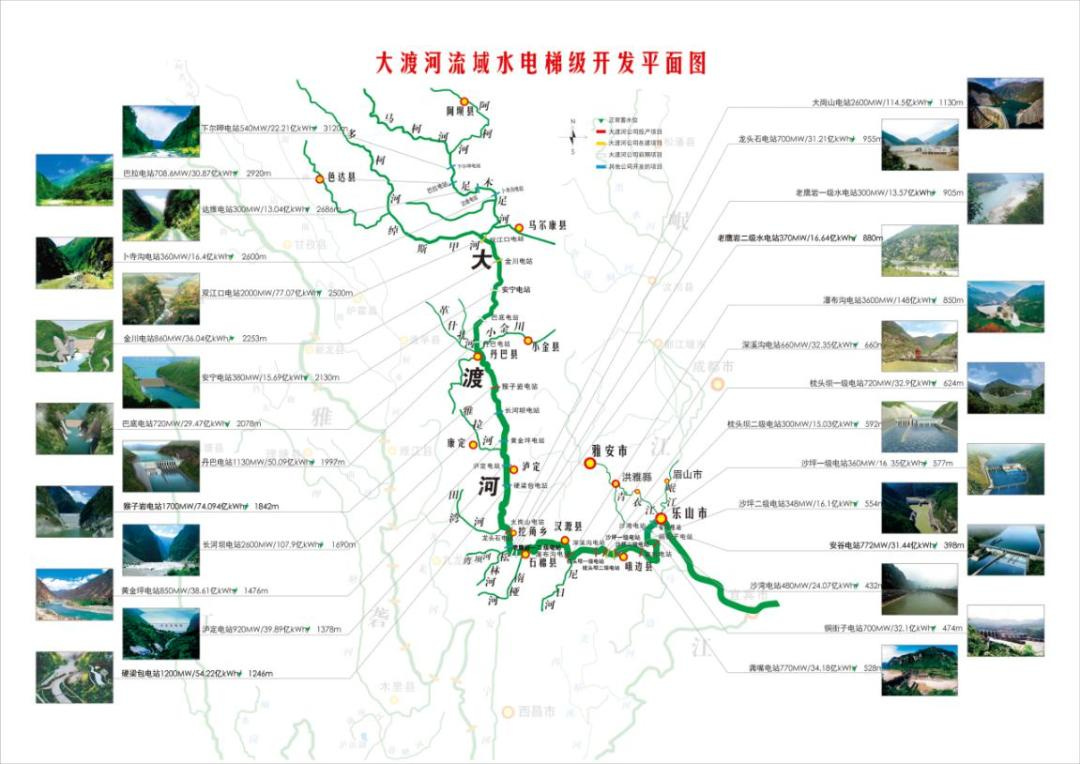
(Map of the Dadu River Cascade Development released by the State Energy Media account. Shuangjiangkou hyperpower station is just one of 28 planned stations.)
In the official story, everything sounds seamless: harnessing water power for “Double Carbon“ goals; building roads for “Han-Tibetan Harmony“; relocating relics as a sign of “cultural confidence.” Every word is “correct.” Every word shines.
But zoom in, and a cruel reality emerges: villages are moved wholesale, and the stone walls and prayer flags of old villages vanish beneath the waterline; residents are forced from valley communities where they have lived for generations, while a new museum is built in a “more rationally planned” location; caves are cut open, packed up, and removed from cliffs where they endured for centuries; a lofty bridge is planted on unstable slopes and, ten months later, slides into the gorge together with the roadbed.
These are not random “incidents.” They are the manifestation of a single top-down power structure and a single development ideology: in the name of the nation and development, massive construction is used to dominate rivers, mountains, villages, and culture. This logic is spreading across all of Tibet.


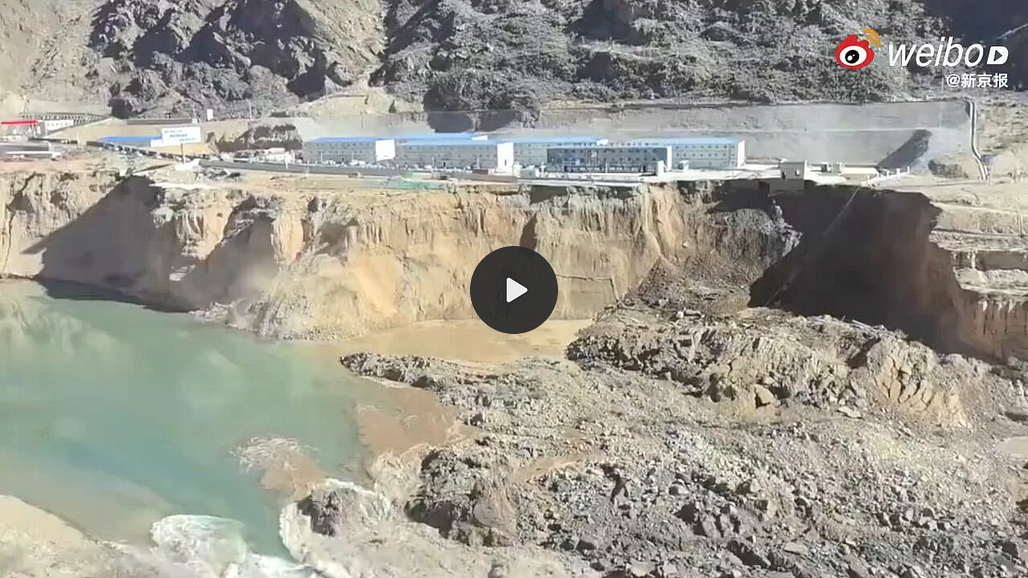
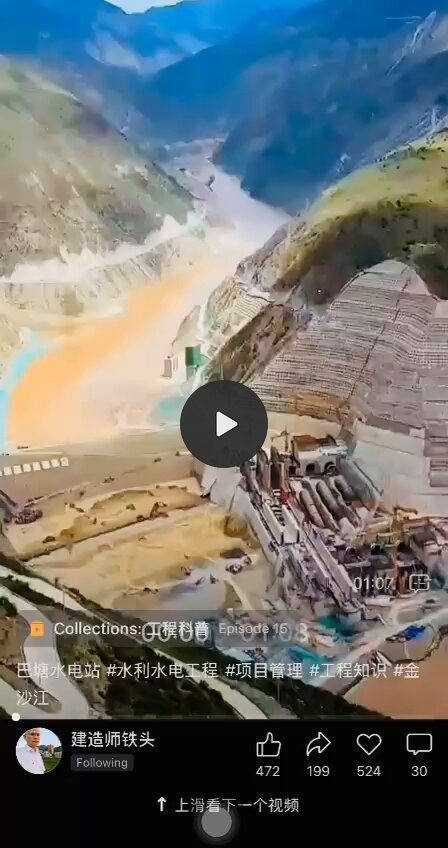
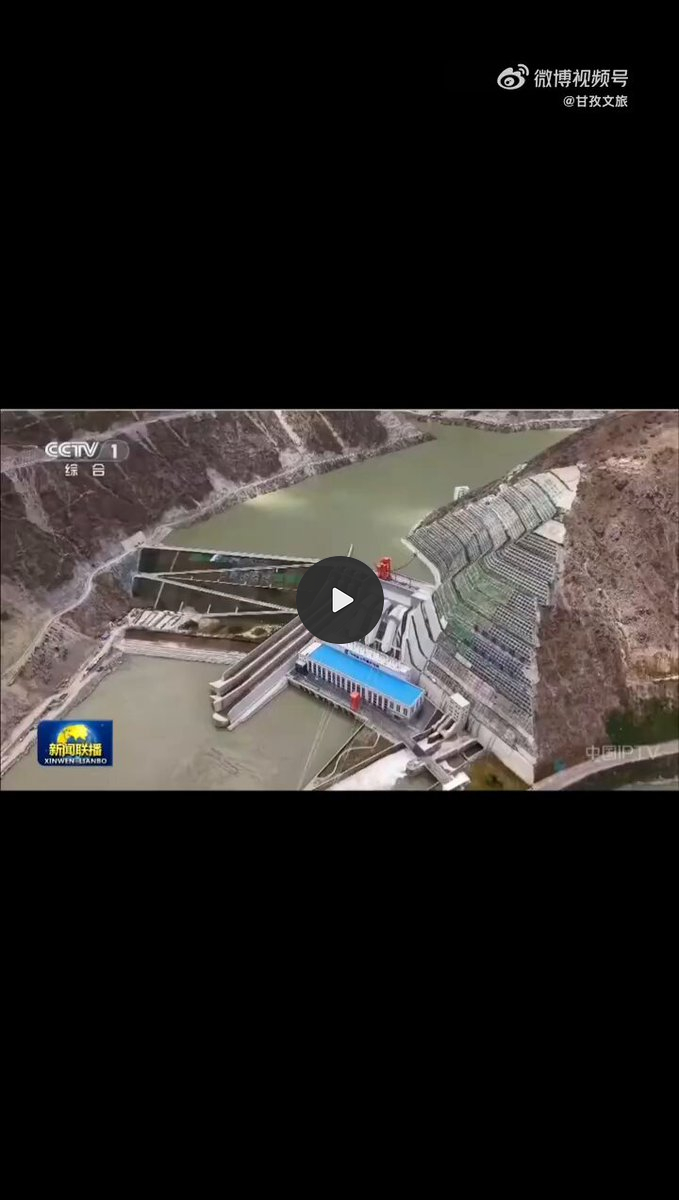
Recently, reports emerged of a large-scale landslide along National Highway G215 near Batang, on the border of Sichuan and Yunnan provinces, causing extensive road closures and blocking the Jinsha River འབྲི་ཆུ , forming a landslide-dammed lake.


Just weeks ago, in Sêrxü County (石渠县 · སེར་ཤུལ་རྫོང་།) —where current Sichuan, TAR, and Qinghai meet — a large-scale detention operation occurred that barely reached the Chinese-language media. In November 2025, in the Kashi (呷依) area of Sêrxü County (石渠县 · སེར་ཤུལ་རྫོང་།), formerly known as སེར་ཤུལ་རྫོང, authorities pushed forward a mining project, prompting over a hundred Tibetans to protest. The state responded with a crackdown, involving heavy police and military deployment. At least eighty Tibetans were detained. Their whereabouts remain unknown.
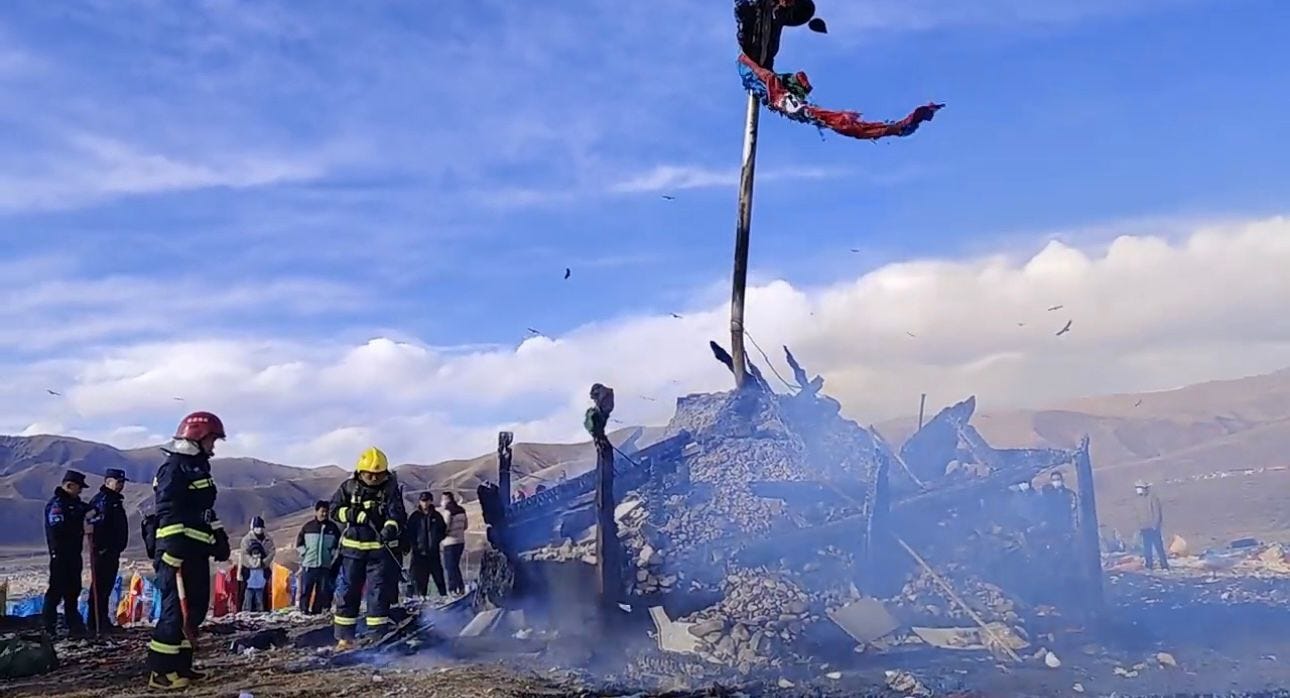
In the same month, authorities burned multiple large prayer-flag installations in Jigzhi County (久治县 · གཅིག་སྒྲིལ་རྫོང་།), Golog Prefecture(果洛州 · མགོ་ལོག་ཁུལ།), Amdo (安多 · ཨ་མདོ་) area, under the guise of “winter fire prevention and environmental cleanup.”
This is a script repeated countless times: when dams are to be built, mines dug, tourist sites developed, Tibetans and Tibetan culture—tupas, flags, and faith—are treated as “obstacles to development” and “threats to unity.” Villages are flooded, sacred objects burned, protesters dragged onto trucks and thrown into detention. Tibetans are merely defending their ancestral lands and their faith, yet in official narratives, they are branded as “troublemakers” or “separatists.”

This narrative has endured for decades: from “liberating serfs” and “land reform” to “Develop the West” and “green low-carbon growth”; from demolishing monasteries and dispersing monastics to turning Tibetan civilizational heritage into playgrounds for tourists and worksites for outside bosses; from suppressing language and belief to covering everything with the rhetoric of “ethnic unity.” In this context, the collapse of Hongqi Bridge and the death of Liu Tuo are two fresh wounds exposed on the surface.
Epilogue: The Dust Settles, the Water Rises
The dust raised by the collapse of the Hongqi Bridge has settled into the valley. Construction crews will soon clear the debris; new technical plans will be discussed, reviewed, and approved. The water in the Shuangjiangkou reservoir will continue to rise, submerging more of the old terrain and villages. The Jiazha’erjia cave murals will be carefully cut from the cliff and moved to modern facilities, where they will be displayed alongside new “authoritative interpretations” on museum placards behind glass cases.
But behind these so-called “progress” and “protection,” from dams to villages, from bridges to caves, lies the cost Tibetans are forced to bear again and again: the loss of home, the loss of sacred ground, and the loss of the chance to decide their own future on their own land.
Liu Tuo’s life ended at 31, but the world he recorded is still speaking to us. The Hongqi Bridge lasted only ten months, but its collapse serves as a reminder: if we do not question the logic that demands everything yield to “development” and “national interest,” the next thing to collapse may not just be a bridge or a hillside, but the memory, faith, and home of an entire ethnic people.


Related information:
Author/ Editor:Yuqiao GD Image:Yuqiao GD Translate:Yuqiao