

Editor’s Note: Today is His Holiness the Dalai Lama’s birthday, and tomorrow is Tara Zhang Yadi’s birthday. Everyone at Chinese Youth Stand for Tibet extends our warmest birthday wishes to both of them!
To mark the occasion, we are republishing a deeply moving essay that Tara wrote two years ago after meeting His Holiness. We hope it offers our readers a glimpse into Tara’s spiritual world. We also dedicate this essay as a birthday tribute to His Holiness, praying for his good health and wishing him a long life for the benefit of all beings!
This article was originally published on Tibet.net (Chinese) two years ago.
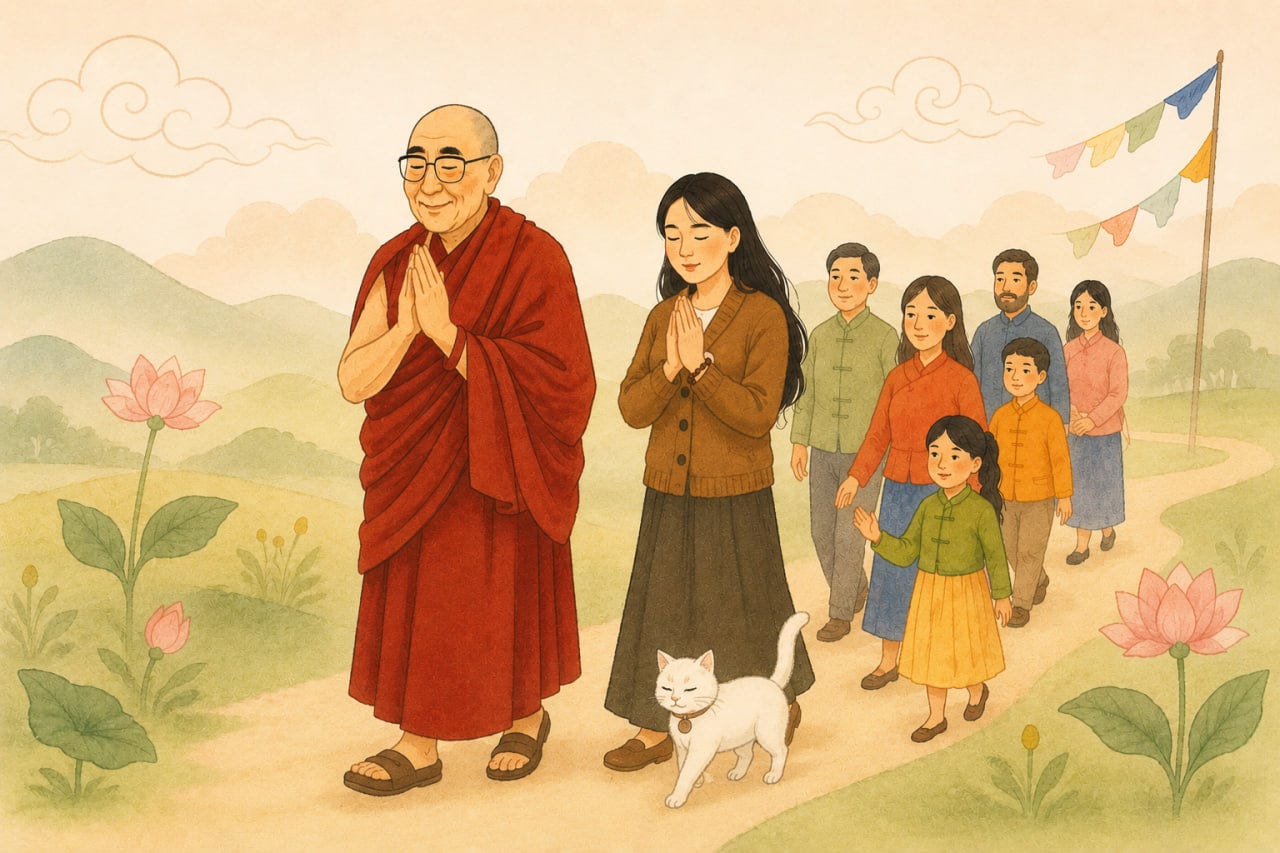
By Tara Freesoul
In early August, during a phone call with a Tibetan friend, I learned almost by chance that His Holiness the Dalai Lama would be passing through Zurich, Switzerland, on his way back to India from New York to preside over a Tenshug (long-life offering ceremony). I understood at once how rare and precious such a karmic condition was, and I gave thanks to the Triple Gem for bestowing upon me such merit. On August 14th, the moment tickets for the ceremony went on sale online, I logged onto the website precisely on time and managed to secure one.
August 25th was a drizzly, overcast day. I arrived early that morning at the Hallenstadion arena in Zurich, and from a distance I could already make out hundreds upon hundreds of Tibetans in traditional chuba robes arranged in several long queues. It seemed as if Tibetan exiles from nearly every European country had come. There were silver-haired elderly women, beautiful and upright young men and women, and toddlers still learning to speak; everyone was dressed in their finest, holding khatags (ceremonial scarves) in their hands and prayer beads around their wrists. All of it was a testament to more than half a century of His Holiness’s efforts: the displaced Tibetan people had found refuge in Western countries, had flourished there, and generation after generation has continued to transmit the faith and culture of Tibet. Scattered among the crowd were many European faces - I even spotted a Swiss girl wearing a lovely chuba.
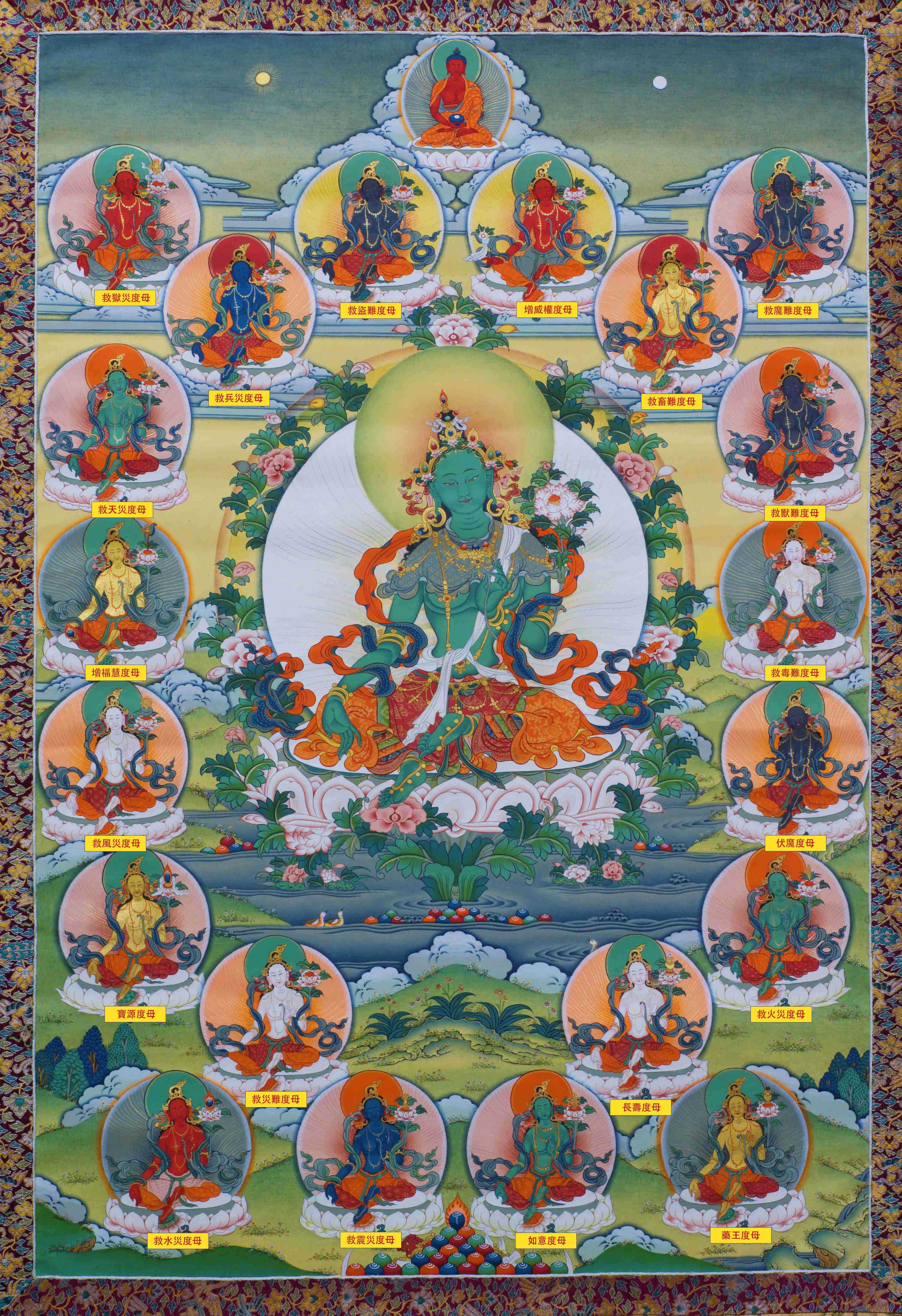
My ticket placed me in seat 21 in a particular section of the arena. By a wonderful coincidence, I turned 21 this year, and the number also symbolizes the 21 Taras.
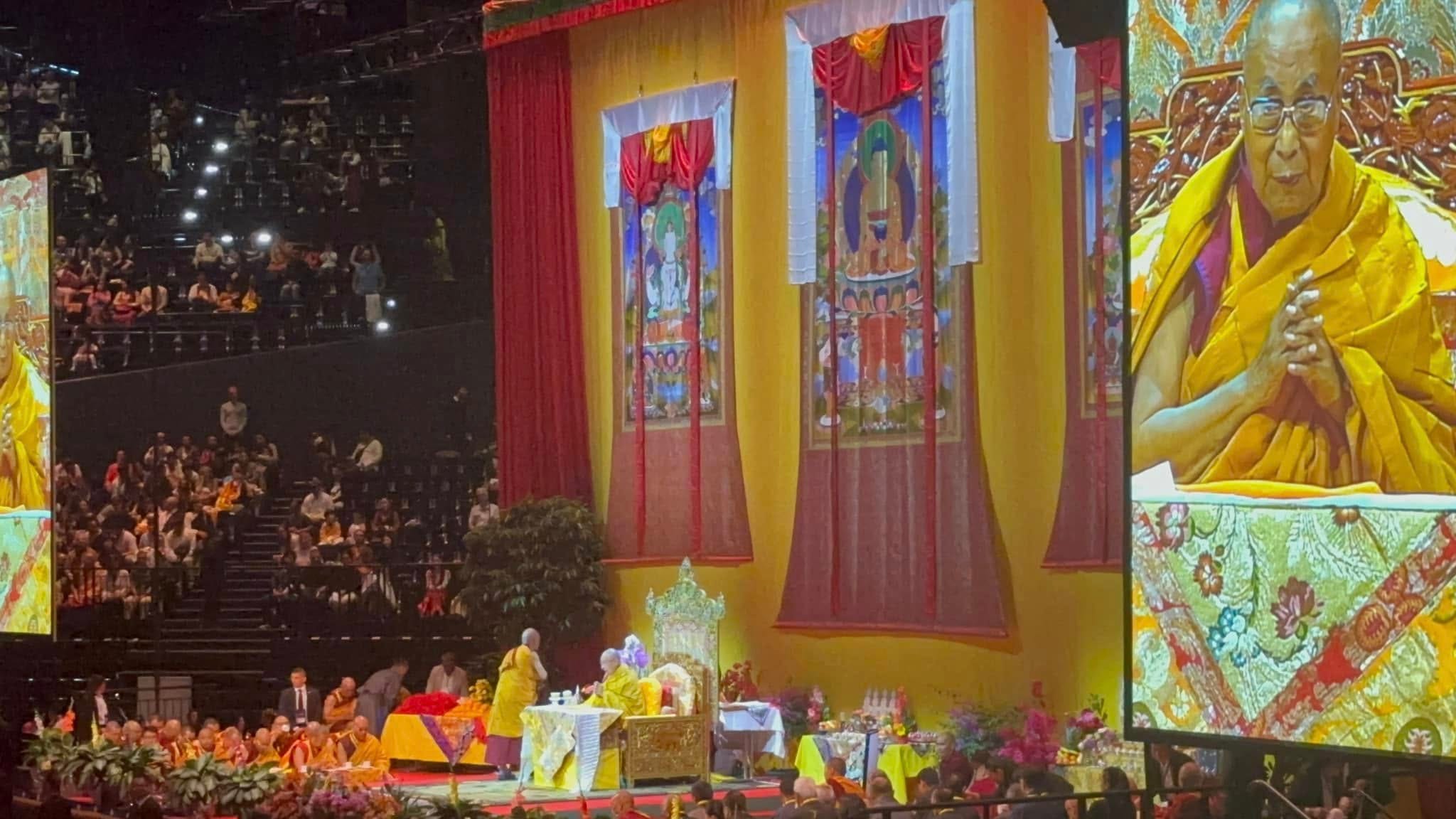
My seat was on the second floor, to the left of His Holiness’s throne. I entered the hall and took my place at around 9:09 in the morning; by then, His Holiness was already seated on the center throne. He was far from me, but I could clearly make out the figure settled at the heart of that solemn golden dais. I could barely believe that what my eyes were seeing was real. Life felt like a dream; watching His Holiness materialize before me, I felt as if I were drifting through one.
His Holiness wore crimson robes draped with a golden kasaya and sat in the full-lotus position upon a golden throne. Behind him hung three enormous thangkas: Shakyamuni Buddha at the center, four-armed Avalokiteshvara to the right, and White Tara to the left. To His Holiness’s right sat the monastic assembly; to his left, the lay disciples.
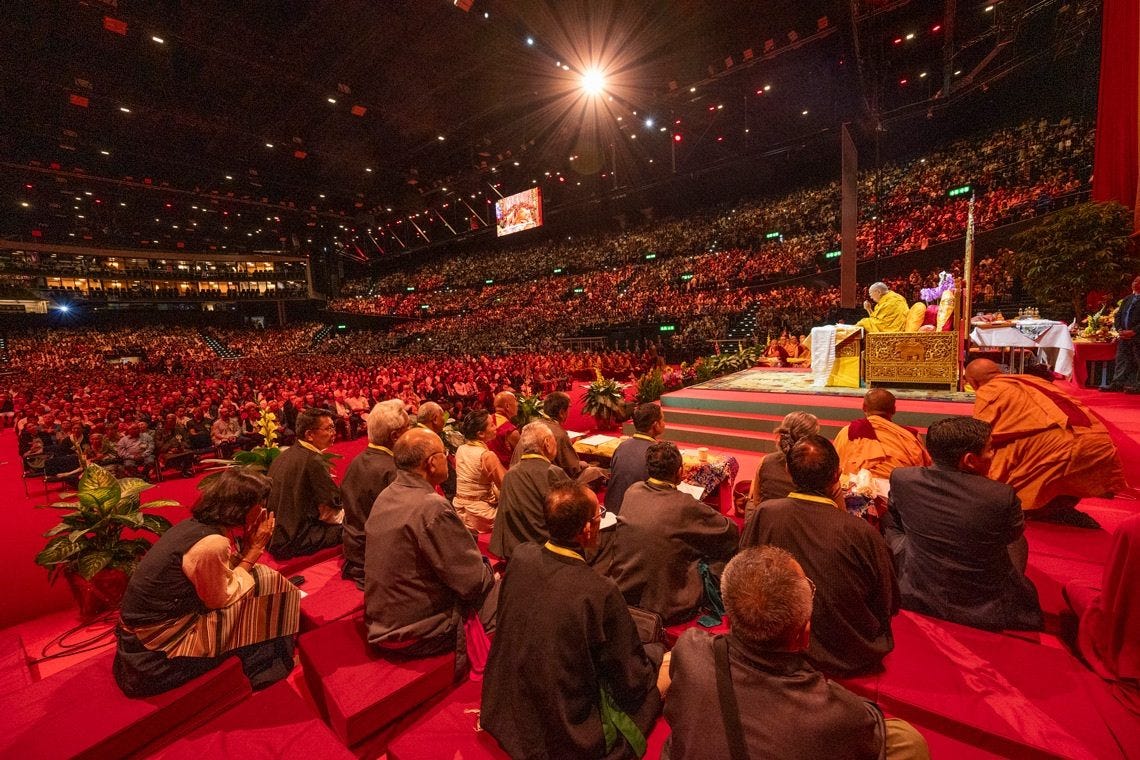
The ceremony began, and I heard His Holiness’s voice teaching the Dharma with my own ears. It sounded so warm and familiar and his articulation was still incredibly clear. I felt deeply ashamed that I hadn’t mastered Tibetan; the only words I could make out were when His Holiness mentioned Mao Zedong (quoting Mao’s dictum that “religion is poison”), and then his admonition to all Buddhist practitioners to cultivate Bodhicitta (the mind of enlightenment). When the camera panned to the audience, I saw some Tibetans wiping away tears, and my own eyes welled up.
Holding my prayer beads, I silently recited the Six-Syllable Mantra round after round in my heart. Gazing up at His Holiness’s face, I thought of the books of his I had read, of the reports and rumors I had encountered about him, and then I thought of his teachings - the core spirit he has spent his life conveying to the world: Be kind.
His Holiness led us in reciting the Refuge Prayer, intoning again and again Om Mani Padme Hum, Om A Ra Pa Ca Na Dhi, followed by the Dedication of Merit...
I became aware that the crying and restless noise of the children around me had faded into silence. It seemed to me that I could see four-armed Avalokiteshvara appearing in golden light above His Holiness, materializing before my very eyes. A profound and boundless peace and joy arose within me - a joy that eclipsed every sorrow I had ever carried. I felt, in that moment, that I had no more regrets in this life.
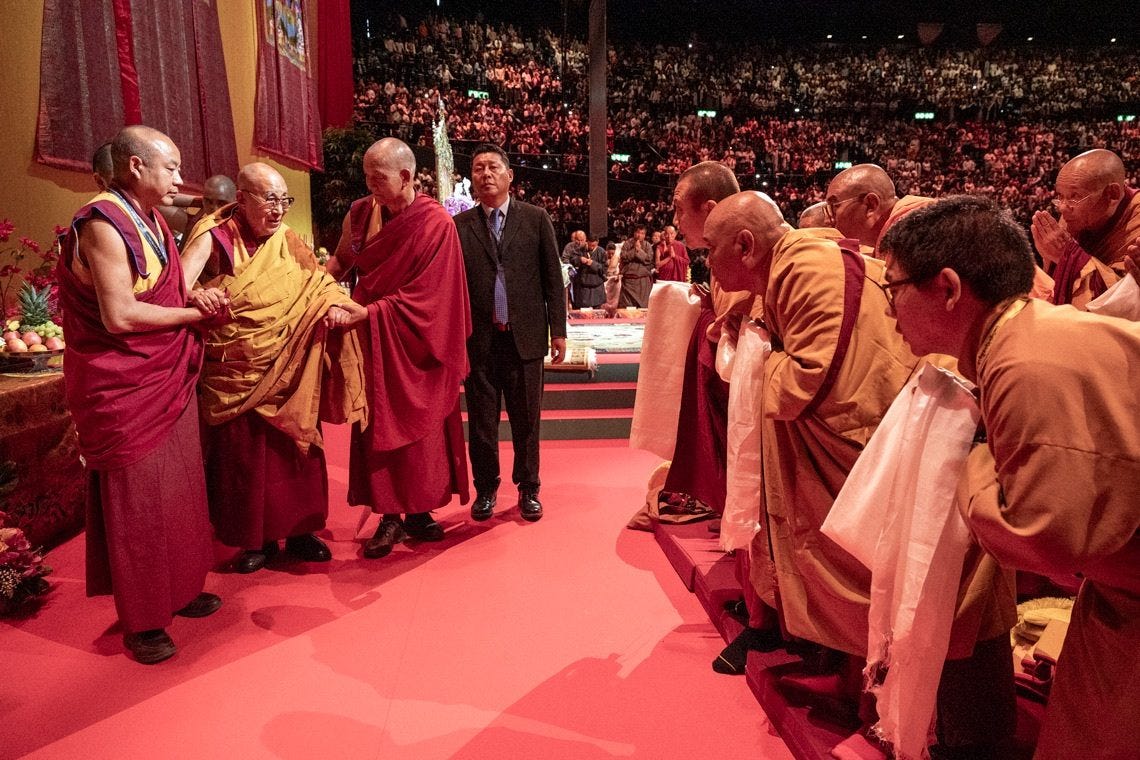
When the ceremony ended, we rose to watch as the monks escorted His Holiness down from the throne. I heard Tibetans calling out with all the force of their lungs: “Long live the Dalai Lama!” “Bhod Gyal Lo!” The entire hall erupted in response. His Holiness heard them. He turned and waved to us.
That afternoon, I offered a khatag at His Holiness’s throne and prostrated before it.
It was only later, when I encountered another Han Chinese friend who practices Tibetan Buddhism at the venue, that I learned the two of us were the only people from mainland China among the tens of thousands of devotees present. This was the greatest honor of our lives.
What merit could I possibly have? How extraordinarily fortunate I am — to have seen His Holiness in my lifetime: the Dharma King of the Buddhafield, the protector of the Land of Snows, the embodiment of Avalokiteshvara, the lamp of the Dharma in the longest of nights, the most noble soul to have taken birth on this earth in this Age of Dharma Decline, my Rinpoche. This was a blessing I had never dared to hope for.
I remember that just the month before, in a Buddhist shrine inside Tibet where His Holiness’s image is kept and venerated in a kind of hushed, clandestine way, I prostrated nine times before his portrait. This was a good auspice. I cannot fathom how many lifetimes I accumulated the merit and virtuous karma to allow me, in this life, to see His Holiness in person while still alive. When I think of the many Tibetans inside Tibet who have been imprisoned for the simple act of venerating His Holiness, while I, a Han Chinese, have had the fortune to see him in person, I am filled with profound guilt.
Here I set down a few lines of verse for His Holiness:
Tibet is his homeland.
The Tibetan people are his flock, whom he shelters and protects.
The snow-capped peaks of the Himalayas are his throne.
He is the sun rising over the mountaintops.
I also recall that four years ago, on July 22nd, 2020, I visited His Holiness’s birthplace in Huangzhong, Xining, Qinghai province. At the time, I wrote these words in my diary:
“Without quite realizing it, I found myself in my Guru’s homeland - Huangzhong, Xining, Qinghai province. his land has nurtured this ancient and mysterious people from generation to generation. By rights, this land should belong to them, not be occupied and subjected to the soul-destroying tyranny of usurpers. And yet today he can never again set foot on his own soil, can never walk beneath these sacred blue skies and across these verdant plains, can never return to the home and the birthplace of his highest convictions whose faith he risked his life to defend , and cannot take the throne that rightfully belongs to him, before which his own people would bow in reverence. Instead, he wanders in a distant land for sixty or seventy years - nearly the whole of a lifetime.
It is enough to make one sigh. The Nobel Peace Prize was not undeserved.
May the Buddha protect this great and extraordinary soul. May the Buddha protect this land and grant its people freedom.”
It was that journey to Qinghai, to His Holiness’s birthplace, that left me utterly captivated by Tibetan culture and ignited in me a deep fascination with the Tibetan language.
I was born and raised in mainland China in the early years of the new millennium. The ethnicity column on my national identity card reads “Han.” But I feel no sense of belonging to that designation. The moral strictures of Confucianism have not succeeded in binding me; the fabricated notion of a unified “Chinese nation” cannot confine me. My heart is as free as the eagle in the sky over Tibet.
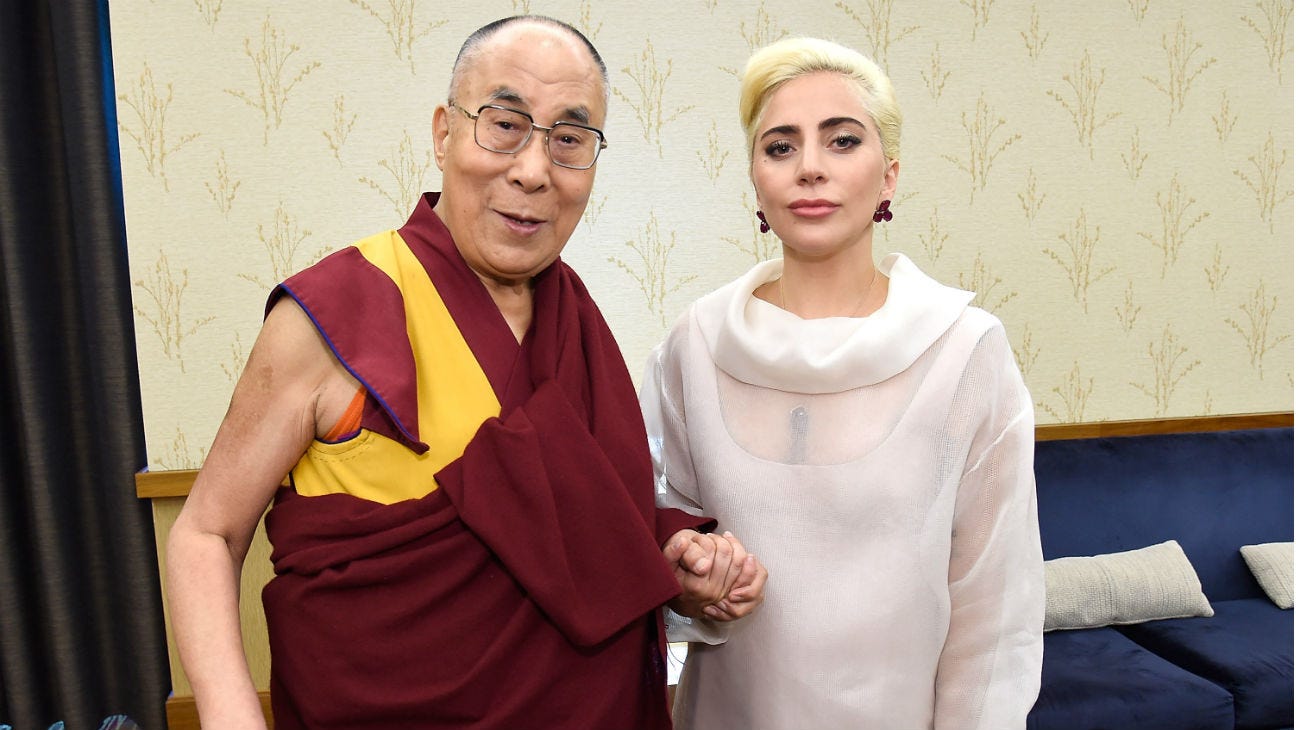
I remember the first time in my life I encountered a photograph of His Holiness was in 2015. I was a fan of Lady Gaga at the time, and her meeting with His Holiness set off an enormous uproar on Chinese social media. Witnessing the torrent of hatred and slander that my country and my people directed at His Holiness, I couldn’t understand why. Curiosity compelled me to use a VPN to download Instagram, where I found the photographs of Lady Gaga with His Holiness. About him I knew only that he was a Tibetan Buddhist monk with kind, gentle eyes and his face even bearing a certain resemblance to my grandfather’s. He had done nothing to violate the natural moral order, certainly not anything as grave as taking a life, and yet he was subjected to such vicious attacks and defamation solely on account of differing political positions. That seemed profoundly wrong. From that moment, I found myself developing a feeling of reverence and affection for His Holiness. Even then, with my halting English and faced with the unbearable insults Chinese netizens were hurling in the Instagram comments, I typed back at them.
My Rinpoche - I was born contrary. The more they hate you, the more I revere you. Love is stronger than hatred.
In 2016, while traveling in Taiwan, I came across a biography of His Holiness at the Eslite Bookstore. I learned that his name was Tenzin Gyatso, that he was a spiritual leader in exile. The book was printed in those beautiful, unfettered traditional Chinese characters that left a deep and lasting impression on me.
I then began searching for materials about His Holiness both within and beyond China’s internet firewall, reading his biographies and coming to understand that, beyond being a spiritual teacher who advocates compassion and nonviolence, he has long been a champion of human rights, autonomy, democracy, environmental protection, and women’s rights. What a supremely perfect and pure soul. I was moved beyond measure by the hardships of his life.
I remember that around 2017, I saved a copy of His Holiness’s autobiography, Freedom in Exile, to my Baidu Netdisk cloud storage. Some time later, the file was blocked with the notice: “This file contains illegal and non-compliant content.” I was furious. I despised a dictatorial government that presumed to screen even the books I read.
I came to understand the terrible karma my ethnic group have accrued: slandering the Buddha, destroying the Dharma, staining the Land of Snows with blood. No number of eons in the Avici hell could redeem it. I cannot fully sever myself from this ethnicity, but I wanted to do something, however small, to atone.
On October 7th, 2022, after I had already left China and entered the free world, I donated 70 Euros to His Holiness’s foundation, the Gaden Phodrang Foundation of the Dalai Lama. It is my honor to have been able to make an offering to His Holiness. May it purify some small portion of my karmic debt.
Since then, I have come to know many Tibetan friends in exile, who have told me how His Holiness, through his life in exile, has made Tibet visible to the world. I have also visited His Holiness’s foundation in Taiwan. These are all threads in the web of my karmic connection with him.
I have dreamed of His Holiness several times. Once, I woke from such a dream nearly in tears. The very morning before I left for Zurich, I dreamed I was attending a lecture by His Holiness.
I have taken refuge under my Guru and received the Samaya vows, yet I am not a good Buddhist. How much sin have I accumulated and my obscurations are so heavy that I do not even know how to begin to confess them. I have fallen into demonic states countless times. I have been mired in transgression, self-harm, and self-abuse, addicted to suffering and degradation. At times I have been consumed by fear, and that fear transformed into hatred, has poured outward: I have hated myself, and I have hated the world. I have always spun within the whirlpool of the five poisons, churning through lifetimes of karmic cycles with no end.
I know full well that Samsara is an endless suffering. My heart longs for liberation, but the weight of past karma and habitual tendencies is so heavy that it always drags me down. I need to confess. My Rinpoche, I beg you to deliver me.
In 2021, I once made a wish that I would travel to Dharamsala in this lifetime and see His Holiness. But I did not dare to believe that wish would ever come true.
I never imagined that such a day could truly arrive in my life. I am grateful beyond measure to the Triple Gem for their compassionate protection. This is the honor of all my lives across all my lifetimes.
May the Triple Gem bless His Holiness; may the Dharma protector Palden Lhamo keep His Holiness long in this world; and may we one day witness His Holiness return to his homeland.
གངས་རི་ར་བའི་བསྐོར་བའི་ཞིང་ཁམས་སུ། །
ཕན་དང་བདེ་བ་མ་ལུས་འབྱུང་བའི་གནས། །
སྤྱན་རས་གཟིགས་དབང་བསྟན་འཛིན་རྒྱ་མཚོ་ཡི། །
ཞབས་པད་བསྐལ་བརྒྱའི་བར་དུ་བརྟན་གྱུར་ཅིག །
In the Land of Snows, encircled by ranges of snow mountains,
The source from which all benefit and happiness arise,
May His Holiness Tenzin Gyatso, the manifestation of Avalokiteshvara,
Remain steadfast among us for hundreds of eons.
August 29, 2024
Source: First published in Tibet.net 图伯特之页|能亲见达赖喇嘛尊者,我此生无憾——一位出生在中国的00后汉人佛教徒的肺腑之言
Editor: GD
Translator: Ashley
Proofreading: Wilson