

Georgetown University 2026 Feb 4th · Event Transcript
Participants: Moderator Dechen Atsatsang · Prof. Mark Giordano · Ambassador Donald Lu· Sikyong Penpa Tsring
【Moderator】 Dechen Atsatsang(Senior, Georgetown School of Foreign Service; Georgetown Human Rights Society)
Good evening, everyone, and thank you so much for coming. My name is Dechen Atsatsang, and I am a senior at Georgetown School of Foreign Service studying international politics, justice, and peace studies, on behalf of Georgetown for Human Rights.
I am really grateful to have you join us for tonight’s conversation on the geopolitical significance of Tibet. Despite Tibet’s central role in regional geopolitics — encompassing questions of environment, security, governance, and human rights — Tibet often remains under-explored in academic and policy spaces. We hope tonight’s discussion offers a meaningful opportunity to engage deeply with those issues, especially here on campus at Georgetown.
It is an honor to have Sikyong Penpa Tsring with us. I am especially thankful to Professor Mark Giordano and Ambassador Donald Lu for being here as well.
Sikyong Penpa Tsring is the President of the Central Tibetan Administration and has dedicated his life to fighting for the rights of the Tibetan people and safeguarding Tibet's culture. As a civil society leader and politician, Sikyong earned his Bachelor of Arts degree from Madras Christian College and served four consecutive terms in the Tibetan Parliament in Exile, serving as Speaker for two of those terms. He also served as Executive Director of the Tibetan Parliamentary and Policy Research Center, and as the representative of His Holiness the Dalai Lama at the Office of Tibet in Washington, D.C.
Since his election as the second democratically elected Sikyong of the Central Tibetan Administration in 2021, he has worked to strengthen the CTA’s governance, advocated for the Tibetan people in meetings with world leaders, raised concerns about the Chinese Communist Party’s policies restricting Tibetan rights and culture, worked tirelessly to secure the release of Tibetan political prisoners, and pursued dialogue with the Chinese government.
I will now turn it over to Professor Mark Giordano for opening remarks. Thank you.
【Opening Remarks】 Prof. Mark Giordano (Georgetown University)
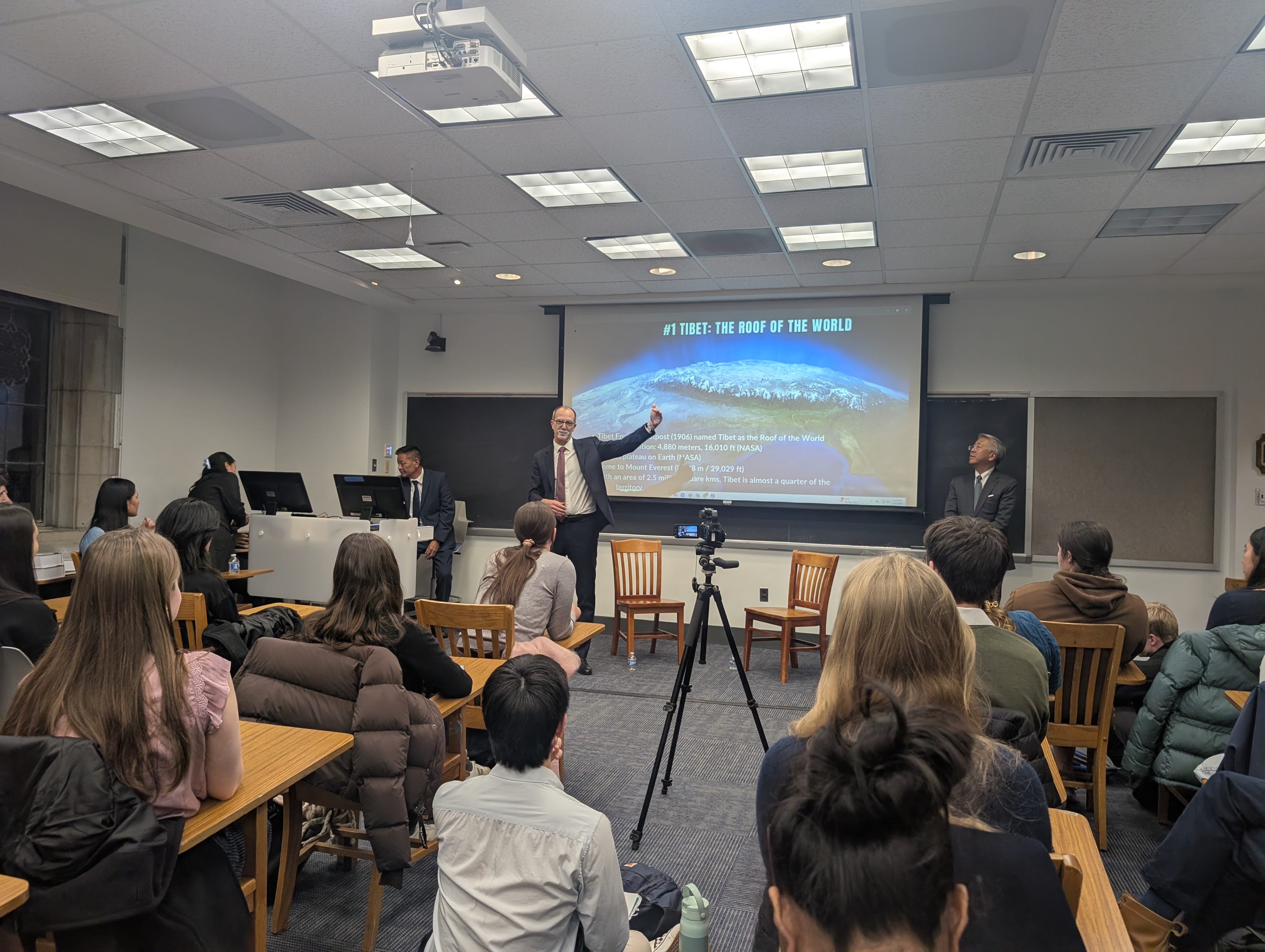
I was asked to come here and give some remarks — to put the Tibetan Plateau in the context of the “Map of the Modern World,” a class many of you are familiar with, because I see many friends out here.
The first thing I want to say is that around the time I arrived at Georgetown, His Holiness the Dalai Lama came to Washington, D.C., and I saw him on stage with Georgetown graduate Nancy Pelosi and Richard Gere. So twelve years later, I think this is another meaningful connection — and we are grateful you are here tonight.
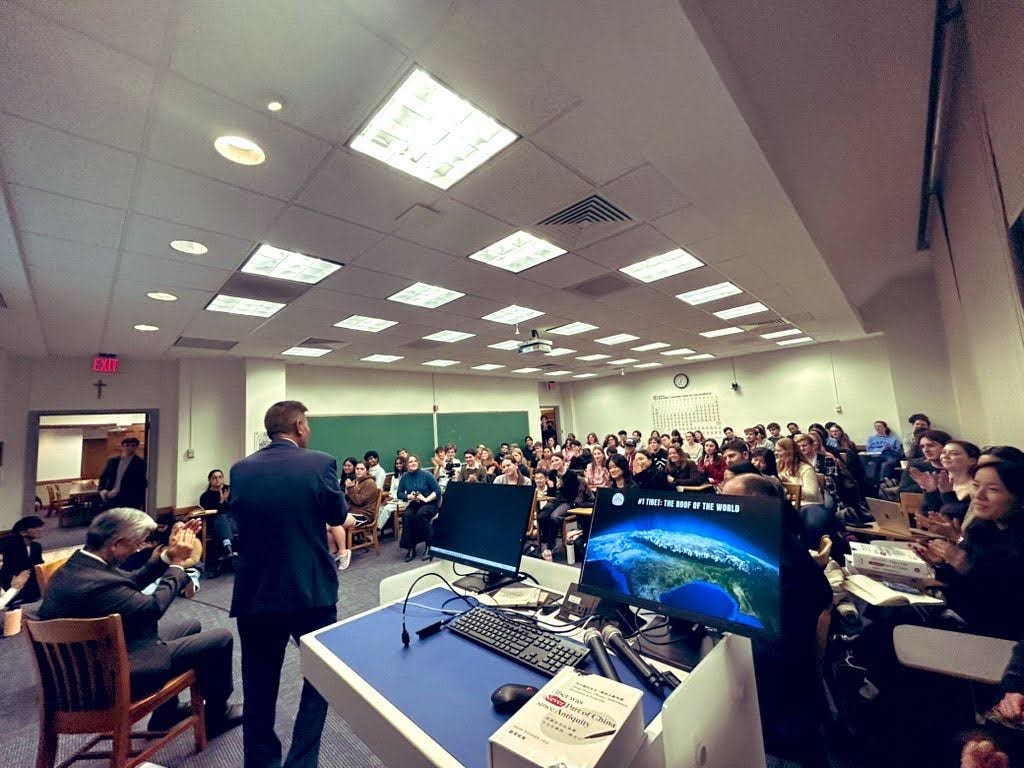
What I want to say about the plateau is well illustrated in this image. On a political map, we look at borders, but we also ask: what crosses those borders invisibly? The Tibetan Plateau is a perfect example. I will frame it in two ways.
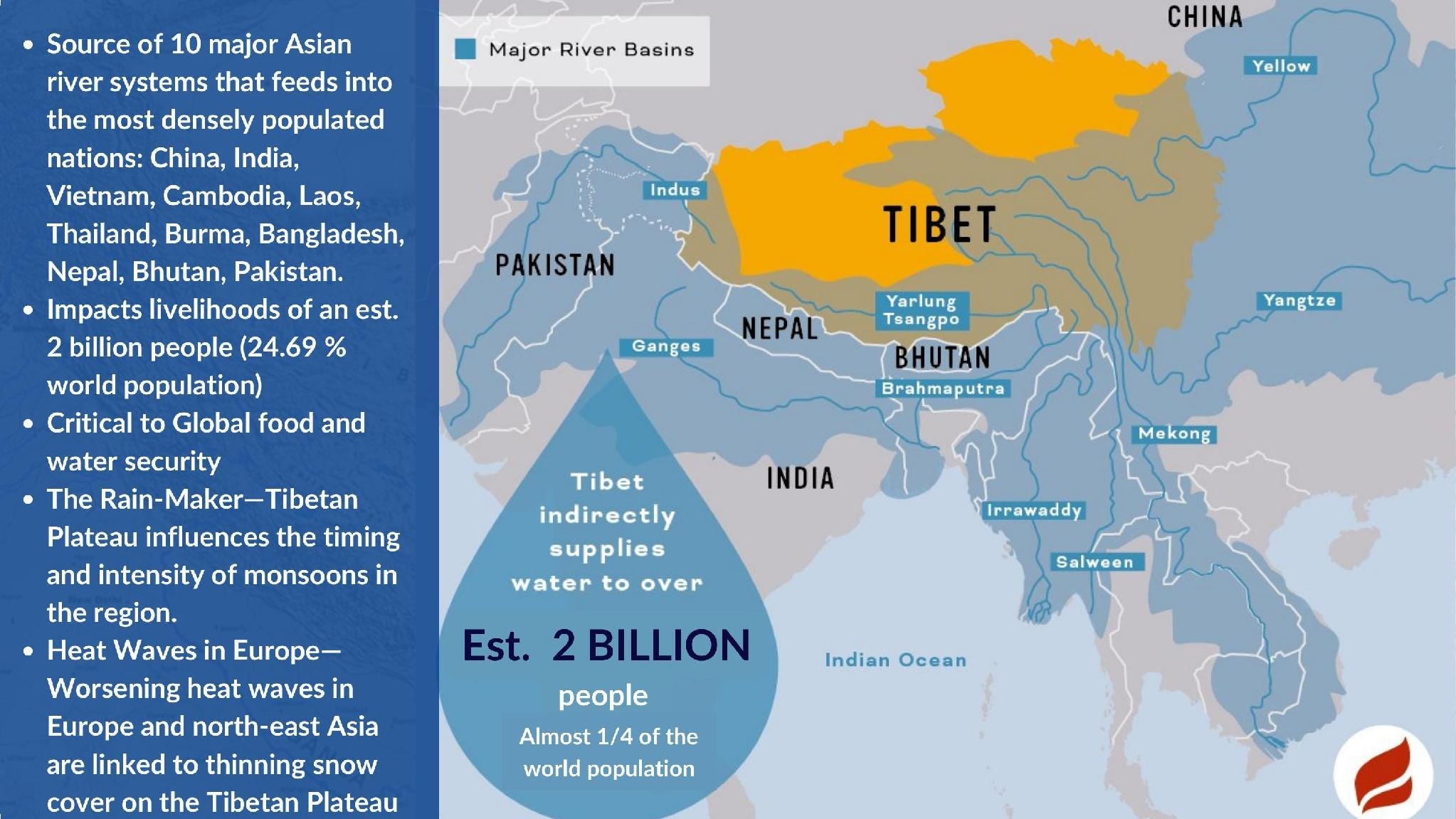
The first is water. The Yangtze, the Yellow River, the Red River, the Mekong, the Irrawaddy, the Brahmaputra, the Ganges, and the Indus — all originate on the plateau. They rise very close to one another, then spread across the continent, supplying drinking water and food for roughly a quarter of the world’s population.
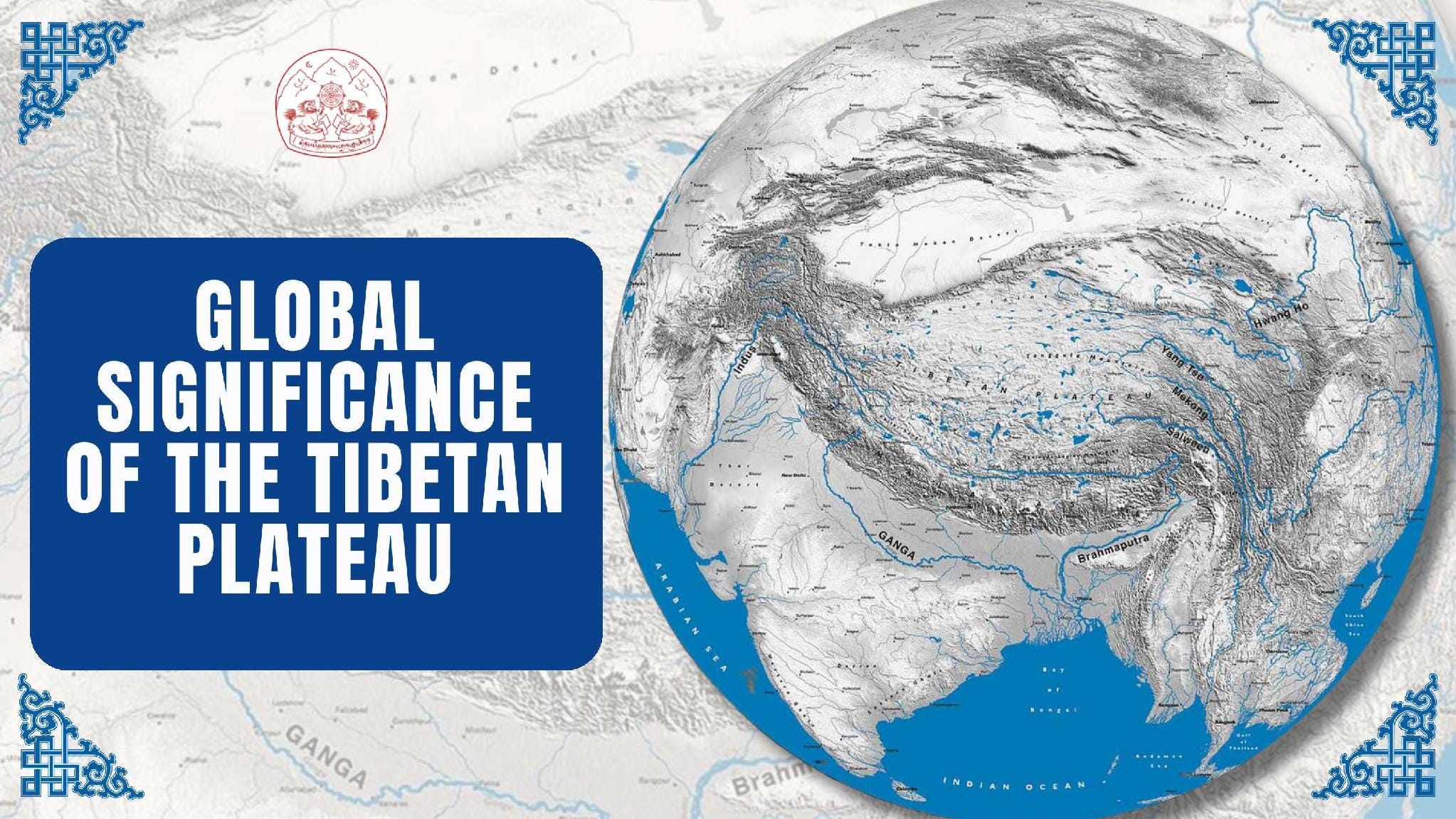
The Tibetan Plateau is the source of Asia’s ten major river systems, sustaining nearly a quarter of humanity.
In the same way, Tibetan ideas and culture are found far beyond the plateau itself. My first interaction with Tibetans was in Yunnan, China, in 1989 — Yunnan is not “Tibet” on any map, but lamas were there. Later in Qinghai (also not called Tibet), lamas again. In Sikkim, India, in what China calls southern Tibet and India calls Arunachal Pradesh, and in Mongolia. At the Smithsonian Asian Art Museum, there is a whole Tibetan room you can experience for yourself.
So we look at what lies within the borders on a political map, but we must also consider how resources, ideas, and spirituality flow across those boundaries. With that, I turn it over to Ambassador Lu for a more formal introduction. Thank you.
【Formal Introduction】 Ambassador Donald Lu (Former U.S. State Department)
Your Excellency Sikyong Penpa Tsring, Professor Giordano, dear friends and colleagues. As I was preparing for this evening, I read the Sikyong’s biography carefully — and I found some remarkable things. For one, you and I graduated from college in the same year. Mr. Sikyong, let me just say: you look young and vibrant. (Sikyong: “I dyed my hair.”)
His journey actually shares remarkable similarities with all of yours. As a young college student in the 1980s, Penpa Tsring was studying in what was then called Madras — now Chennai, in southern India, which is very warm, much like this classroom. But at that time, there was terrible repression in Tibet. Monks and nuns were leading demonstrations to express concern about the influx of Han Chinese and the tightening grip of Beijing.
That young student joined the Tibetan freedom movement and used his voice to speak out for the Tibetan people — much like all of you have gathered here tonight, to learn about and to stand up for those whose rights are threatened.
That led him to work with NGOs — many of you intern with or have worked with NGOs. Then, to think tanks — some of you have done think-tank work. And ultimately to the Tibetan Parliament in Exile.
Ten years ago, Penpa Tsring came to Washington as His Holiness’s representative to North America. He became a Washingtonian too — someone who has learned to love this city.
I retired a few months ago from the State Department after working on Tibetan issues for more than thirty years. One thing that always struck me is how bipartisan U.S. support for Tibet is — for the Tibetan people, the Central Tibetan Administration, and His Holiness. And what we are seeing right now is that President Trump is continuing that long-standing bipartisan tradition.
In July 2020, President Trump wrote a historic letter to His Holiness, congratulating him on his 85th birthday and inviting him to the White House. That same year, Sikyong Lobsang Sangay made the first-ever Sikyong visit to the White House. In December 2020, President Trump signed the historic Tibetan Policy and Support Act, which requires the U.S. government to recognize only the Tibetan Buddhist community’s decision on the selection of Buddhist leaders, including the next Dalai Lama; mandates sanctions against Chinese officials who interfere; and formally recognizes the CTA and Sikyong as the legitimate representatives of the Tibetan diaspora.
We are so fortunate today to hear from someone who has fought his whole life for the dignity and universal human rights of the Tibetan people — someone whose journey began, like yours, as a college student standing up for human rights. Please join me in welcoming Sikyong Penpa Tsring.
【Main Address】 Sikyong Penpa Tsring (President, Central Tibetan Administration)
It’s good to see Donald again. He served as Assistant Secretary of State covering Nepal and Tibetan issues. Around two years ago, the Special Coordinator for Tibetan Issues, Azra Zehra, together with Donald and Ambassador Eric Garcetti, met His Holiness in Delhi, and we had a very productive conversation following up on that.
Thank you, Professor Mark — I have been asking him to serve as a consultant on water issues. We have a shortage of human and financial resources, so we need experts like Mark, and today we have found one more resource here at Georgetown.
Let me begin with some good news. We have been working with the U.S. Congress for a long time. I always say: we are bearing the fruit of His Holiness’s labor. The recent appropriations bill was passed, though there was a scare when all foreign assistance, including the Tibet Fund, was cut last year. Working closely with the State Department and Congress, we secured bipartisan, bicameral support. The new appropriation allocates approximately $13 million for the Tibetan people.
Two days ago we learned that a Special Coordinator for Tibetan Issues has been appointed — Riley Barnes — even though it was not publicly announced. The State Department also confirmed the Tibetan New Year event, with the invitation going out from Barnes in his capacity as Special Coordinator. Another piece of good news: His Holiness will win a Grammy Award. It is a surprise to everyone — His Holiness does not sing and is not especially into music — but he has won. And there is a powerful film, The Wisdom of Happiness, based on interviews with His Holiness, which Richard Gere is currently promoting worldwide.
In the new appropriations language, it states that for the purposes of the act the Central Tibetan Administration will be considered the Tibetan Government in Exile. This is a step forward in our U.S. advocacy, and we are working with members of Congress to advance legislation that would formalize the CTA’s legitimacy — and potentially recognize the Tibetan Government in Exile.
Tibet: Geography and Geopolitics
Our position is clear: Tibet has been an independent nation for centuries — until Communist China invaded in 1950. It has been almost seventy-five years since China occupied Tibet, and almost 66 years since we came into exile.
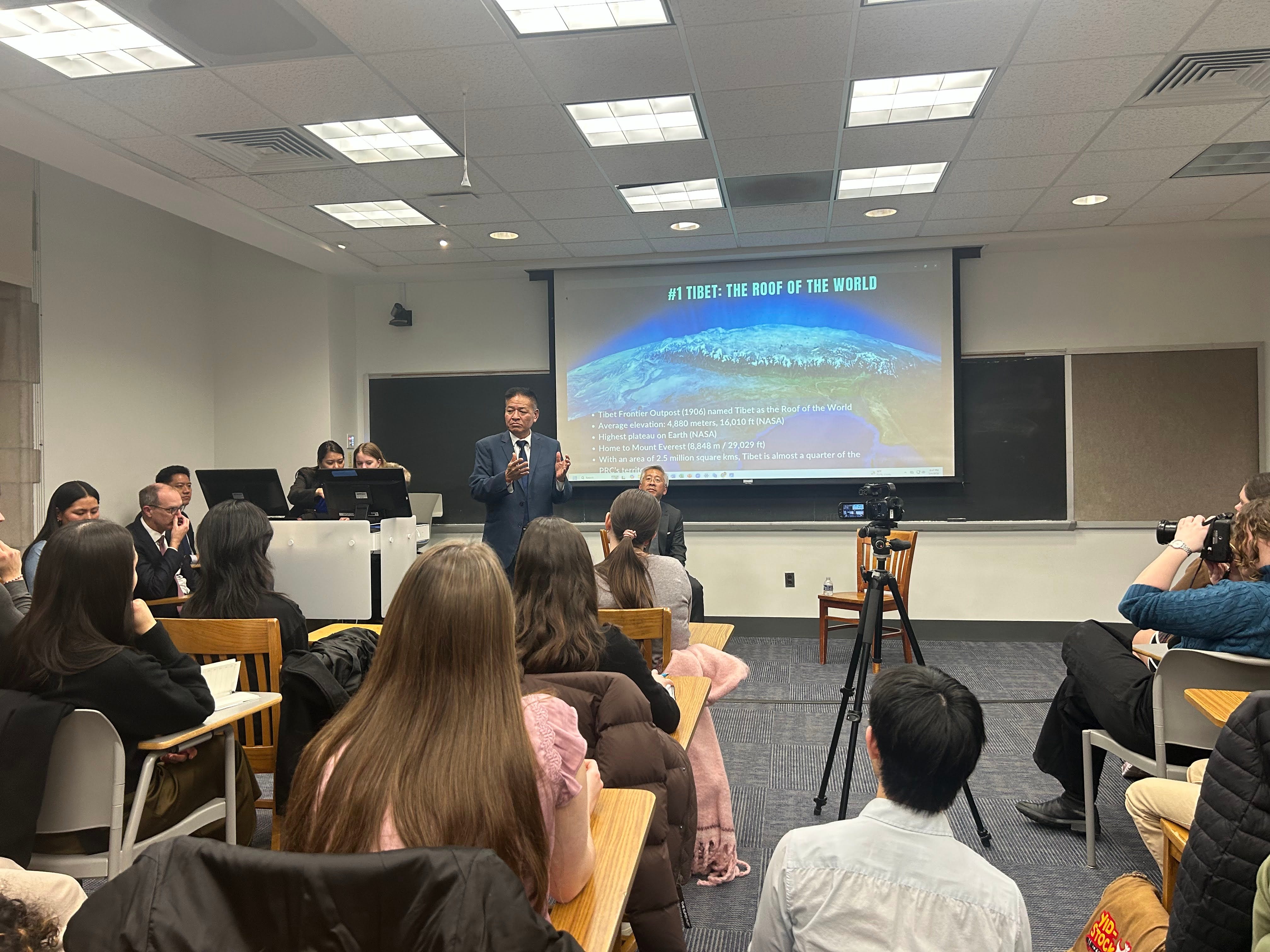
To understand Tibetan history, you must understand Tibetan geography. The Tibetan Plateau is the highest and largest plateau on Earth. It emerged fifty million years ago from the collision of the Indian and Eurasian tectonic plates. Geologists say the Himalayas are still rising by ten millimeters every year, which is also why the entire region is a seismic zone.
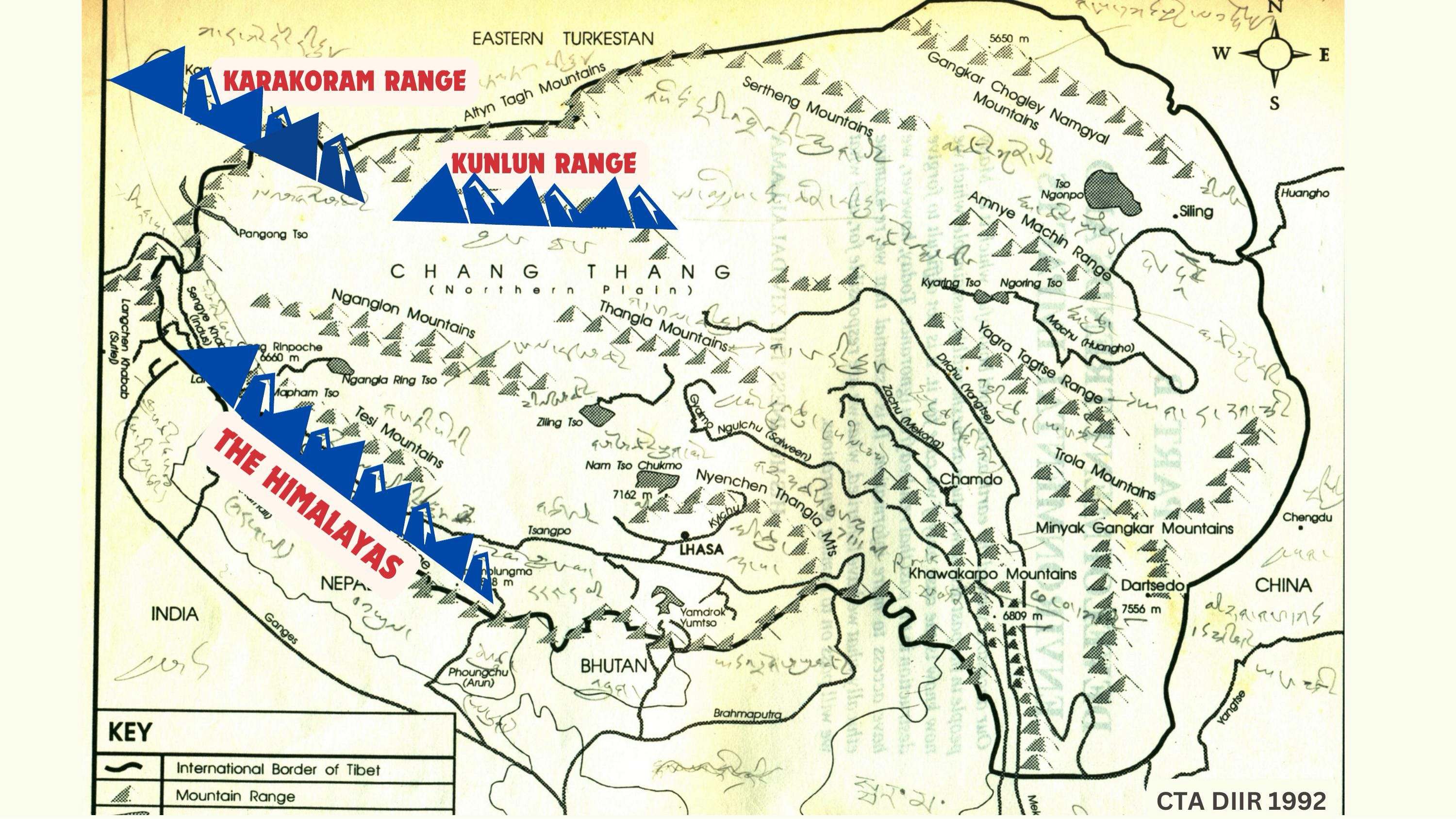
We call ourselves “the land surrounded by snow mountain ranges” — the Himalayas to the south, the Karakoram to the west, the Kunlun and Tanggula ranges to the north. Tibet’s average elevation is approximately 4,800 meters (15,748 ft). Early Western explorers called it “the Roof of the World.”
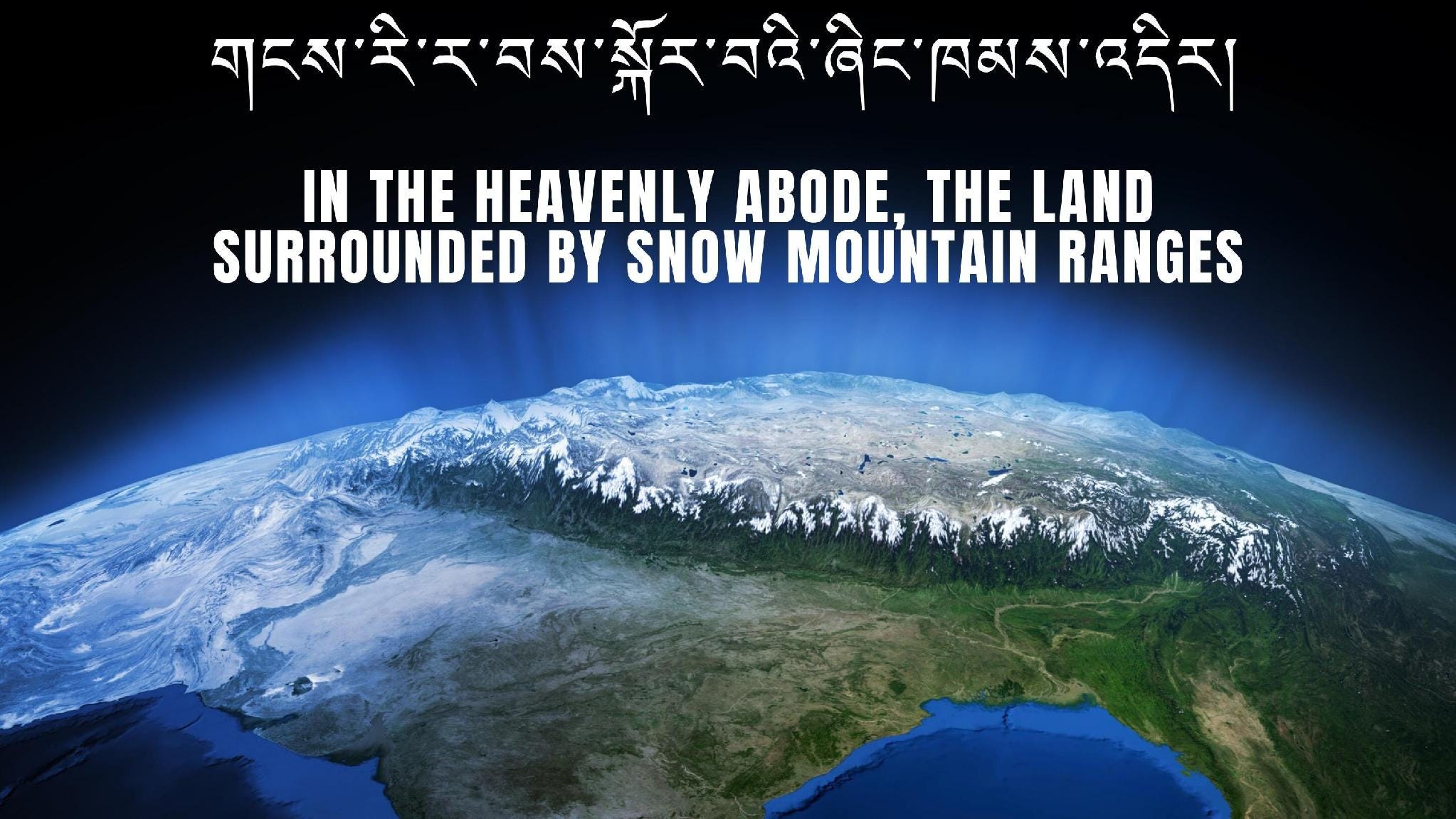
In the Heavenly Abode, the land surrounded by snow mountain ranges.
Chinese environmental scientists today call Tibet the “Third Pole” because it holds the world’s largest reserves of glaciers and permafrost outside the Arctic and Antarctic. These feed all of Asia’s major river systems, which is why Tibet is also called “the Water Tower of Asia.”
China’s Yellow River and Yangtze are the lifelines of its population of 1.4 billion. Without them, China cannot feed its people. The Mekong flows into five Southeast Asian nations; the Salween and Irrawaddy into Myanmar; the Brahmaputra into India and Bangladesh.
China is now building a mega-dam at the Great Bend of the Brahmaputra/Yarlung Tsangpo — a project that will generate 2.8 times the hydroelectricity of the Three Gorges Dam. India has called it a potential “water bomb.” The entire region is seismically active; a dam failure would be catastrophic downstream.
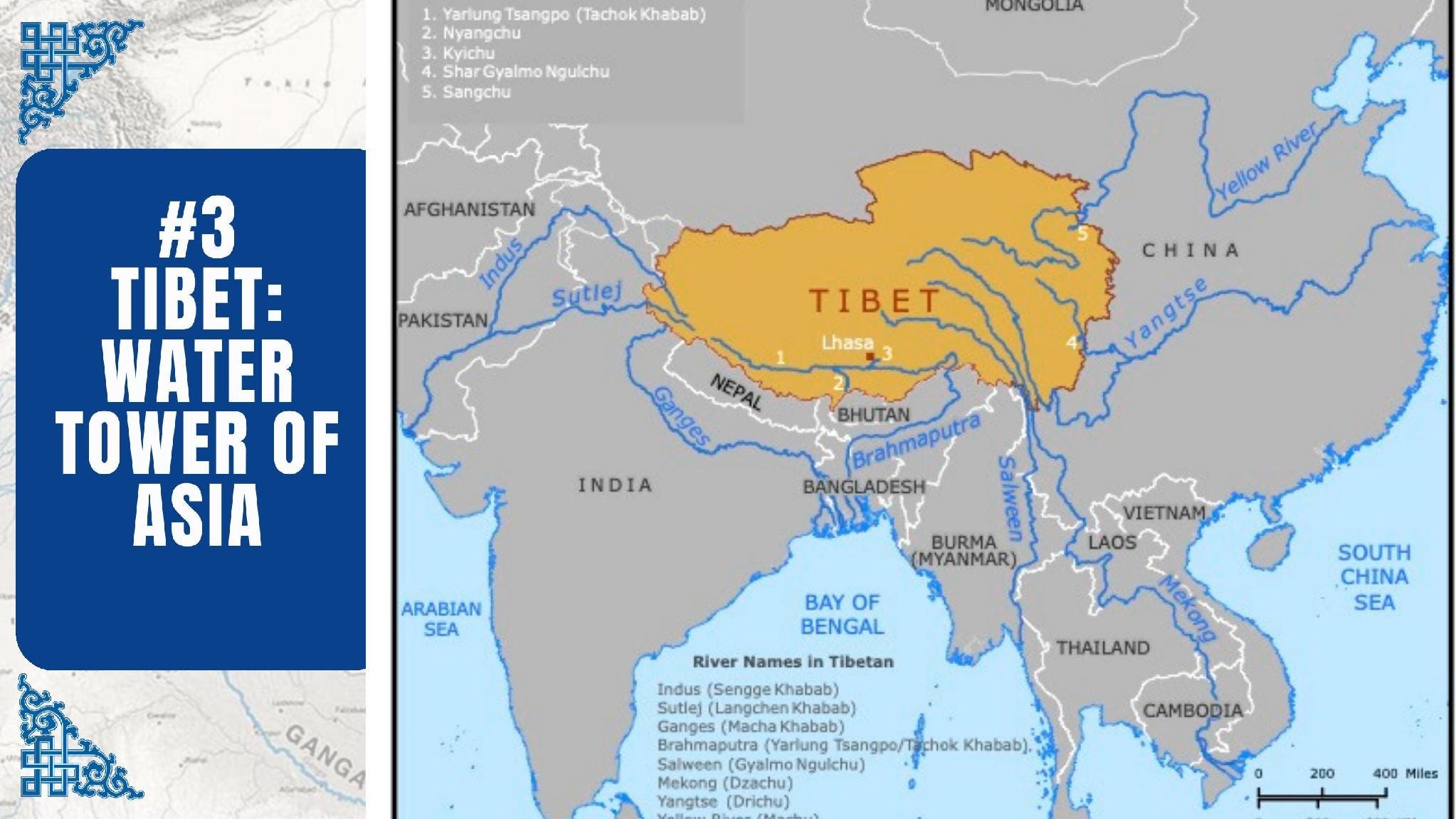
Water Tower of Asia — source of ten major river systems serving the most densely populated nations on Earth.
China does not share hydrological data with any downstream country. We are talking about at least 193 hydropower projects on Tibetan rivers inside Tibet, before the water crosses into any other country, yet all that electricity is transferred to eastern China to power industry, not to serve the Tibetan people.
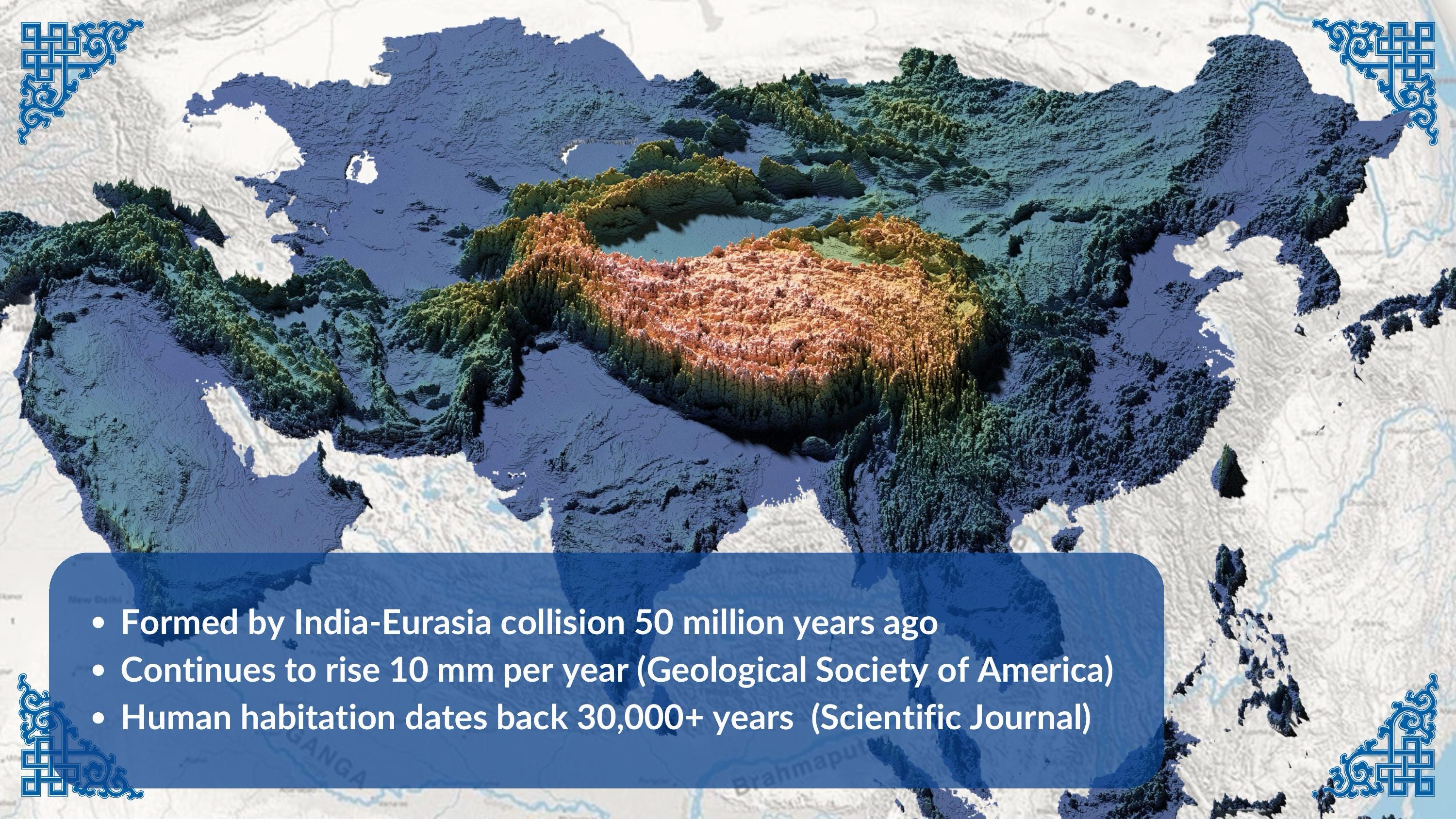
Formed 50 million years ago by the collision of the Indian Plate and the Eurasian Plate, it continues to rise by 10 millimeters annually.
Because Tibet has always been an independent buffer between China and India, there was historically never a common border — and never a war — between the two. Only after China occupied Tibet in 1950 did the first India-China war occur in 1962. India still officially calls the boundary the “Indo-Tibetan Border” and maintains an Indo-Tibetan Border Police — a reflection of India’s principled position.
History: Tibet, Mongolia, and China
Tibet has a widely accepted history of approximately 2,200 years — though human habitation on the plateau dates back more than 100,000 years. Between the 7th and 9th centuries, Tibet was a great empire in Central Asia, at its height capturing the Tang capital and reaching as far as present-day Samarkand in Uzbekistan. After about 400 years of fragmentation, new powers emerged.
In the 7th century, we invented the Tibetan script, derived from Indian Devanagari, entirely distinct from Chinese. When Indian Buddhist masters came to Tibet, they encouraged Tibetans to transliterate the entire Buddhist canon into their own language. Over 500 years, from the 8th to the 13th century, before Buddhism nearly vanished from India, Tibetans translated every available Sanskrit and Pali text. Today, if you want to study Buddhism in its totality, Tibetan is the only language in the world that contains the complete canon. Last December 14th, we presented 223 volumes of a Tibetan-to-Tibetan dictionary to the Library of Congress.
In the 13th century, Tibet developed its unique “priest-patron” relationship with the Mongols — not as subjects, but as spiritual teachers. The Mongols became Buddhists; today, all Mongolians are Buddhists. A few decades later Kublai Khan invaded China in 1271. Our relationship was always with the Mongols — not the Chinese emperors. The Mongols ruled China from 1271 to 1368; when the Ming (the first Han Chinese dynasty) expelled them, Tibet had its own line of rulers — the Sakya Lamas, the Phagmodrupa, and eventually the 5th Dalai Lama, who took over temporal and spiritual leadership in 1642.
During the Ming dynasty (1368–1644) there was very little political relationship between Tibet and China — only occasional exchanges of lamas and titles. The Ming were, in turn, overthrown not by Han Chinese but by the Manchus (the Qing dynasty). Manchu influence in Tibet grew in the 18th century, primarily to help Tibetans resist Nepalese incursions — not to occupy Tibet.
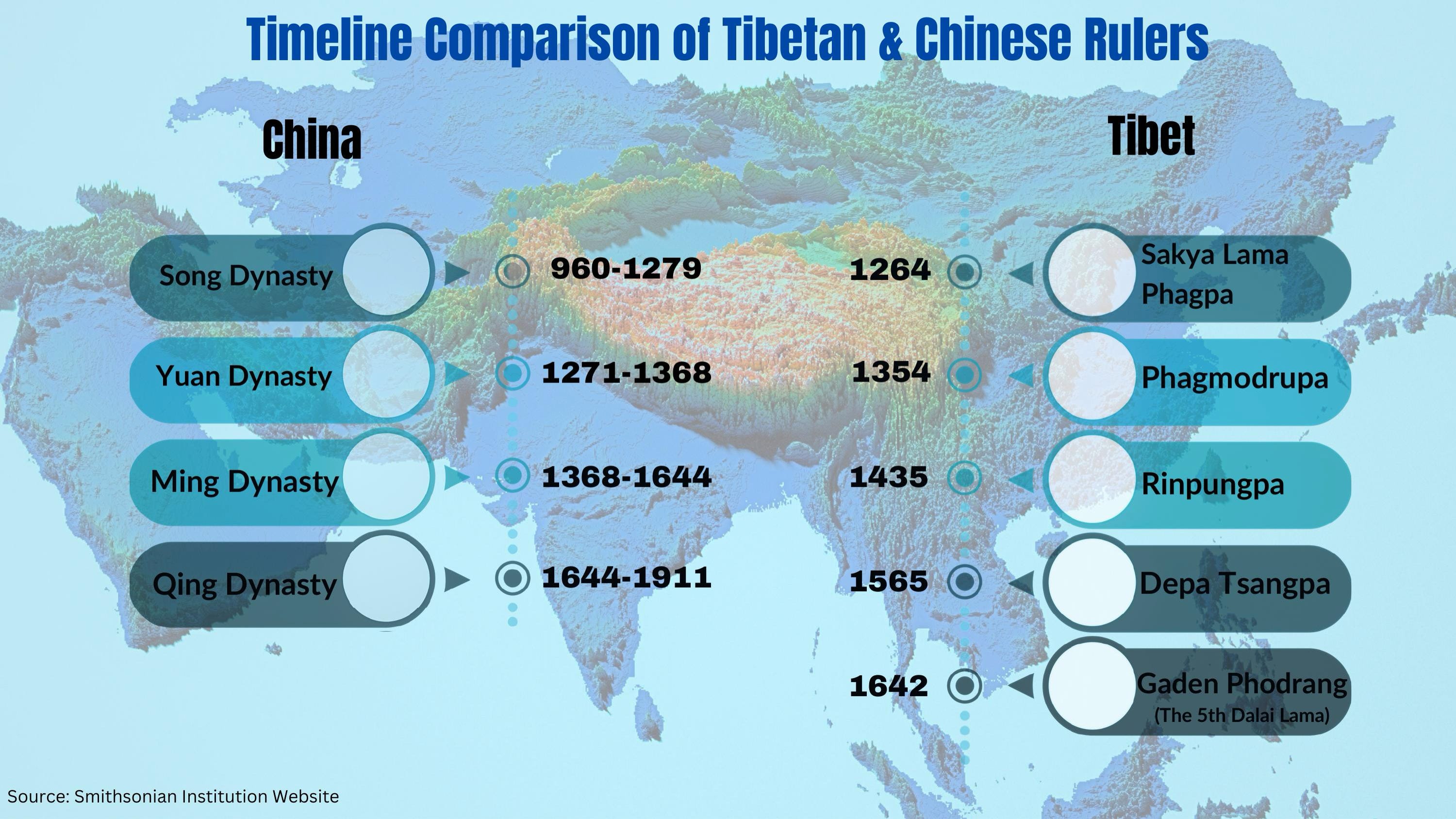
After the fall of the Qing dynasty, Chinese nationalists came to power and incorporated the claim that Tibet is part of China into the modern nationalist narrative. The Chinese Communist Party later inherited and continued this narrative, giving rise to the familiar slogan that Tibet has been an inseparable part of China since ancient times. Yet the Chinese government itself has never clearly defined what exactly “since ancient times” is supposed to mean.
The reason I came here today is to introduce a new book written by a Chinese professor. As a university student, he was taught that Tibet had been part of China since ancient times. Later, however, he noticed that the Chinese government consistently asks foreign governments to recognize Tibet as part of the People’s Republic of China. That made him wonder: if Tibet has always been part of China, why would such recognition still be necessary?
This question led him to conduct a detailed historical investigation. He examined official Chinese historical records from the Ming and Qing dynasties, relying exclusively on Chinese government publications printed before 1949. His conclusion is straightforward: he found no historical evidence supporting the claim that Tibet has been part of China since ancient times. The Chinese edition of his book was published in 2019, and to this day the Chinese government has not produced a substantive response to his findings.
The Middle Way Policy and Current Engagement
From 1959 to around 1973 we pursued independence; not a single government supported us. His Holiness then proposed the Middle Way — a Buddhist concept (Madhyamaka) of avoiding extremes. His Holiness’s elder brother met Deng Xiaoping in 1979; Deng said, “We can discuss anything except independence.” We took that as an opening and sent fact-finding delegations to Tibet in the early 1980s. A window of dialogue briefly opened under Hu Yaobang, then closed.

In 1987, His Holiness put forward the Five-Point Peace Proposal: transform Tibet into a zone of peace; end the transfer of Han Chinese into Tibet; respect fundamental rights and democratic freedoms; restore and protect Tibet’s natural environment; begin earnest negotiations on the future of Tibet. No positive response came from China.
His Holiness then consulted the Tibetan people. The overwhelming public opinion — and the unanimous vote of the Tibetan Parliament in Exile — was: whatever His Holiness decides, we will abide by it. His Holiness reiterated the Middle Way: a non-violent, negotiated solution mutually beneficial to both Tibetans and Chinese.
From 2002 to 2010, there were nine rounds of talks between Tibetan envoys and Chinese officials. Ultimately, China used these primarily to ensure no disruption during the 2008 Olympics. Dialogue has been frozen since 2010. During my term, there have been back-channel contacts, but nothing substantive — particularly given Xi Jinping’s approach.
In July 2024, President Biden signed the Resolve Tibet Act, which states the Tibet dispute has yet to be resolved; calls for resolution under international law; affirms the Tibetan people’s right to self-determination; and — most significantly — formally states that the United States does not accept China’s false historical narrative that Tibet has been part of China “since antiquity.” This is the first time a government has officially pushed back on that claim.
Now let me turn to the question of the Dalai Lama’s reincarnation. The Chinese government is actually less concerned with the current Dalai Lama than with his successor. They understand that if they can control the Fifteenth Dalai Lama’s reincarnation, they believe they can also control the devotion and loyalty of Tibetan Buddhists. In many ways, they are waiting for the present Dalai Lama to pass away.
In 2007, the Chinese government issued what is known as State Religious Affairs Bureau Order No. 5, which claims that the Chinese state has the final authority to approve the reincarnations of Tibetan Buddhist lamas.
His Holiness’s response has been remarkably clear. He has said, “I will be reborn in a free world. If, by that time, Tibet and China are still not free, the Dalai Lama will not be reborn there.”
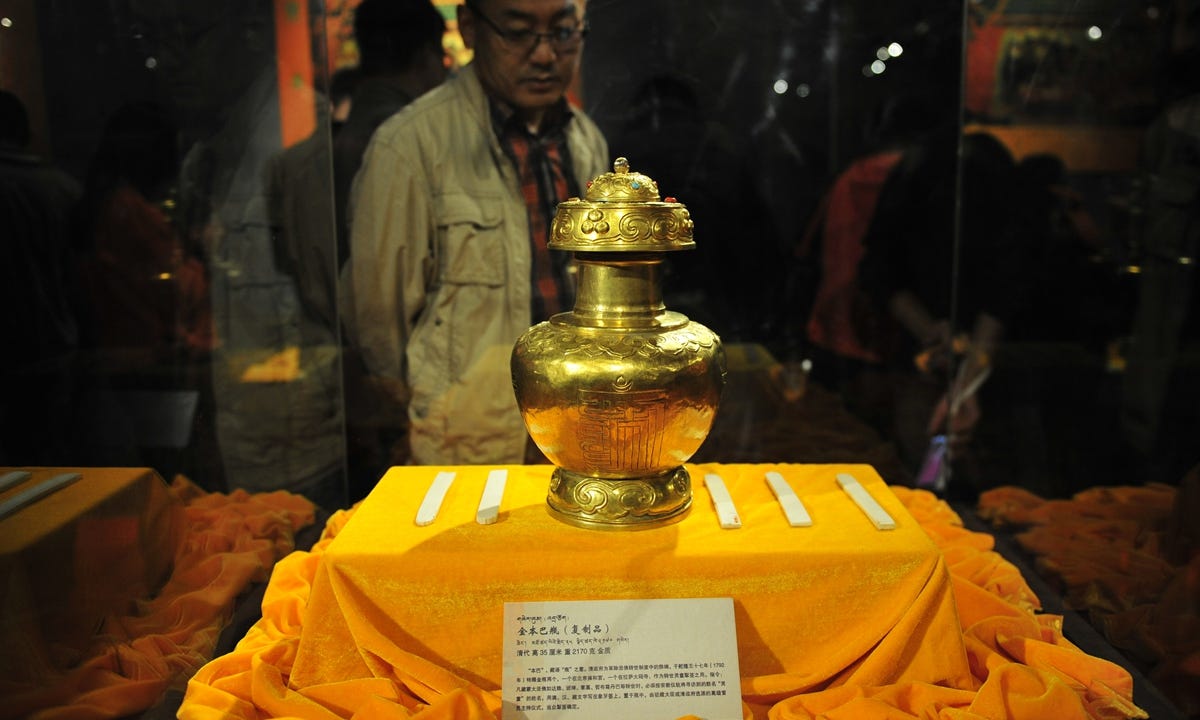
The Chinese government’s second argument is that, according to tradition, the selection of reincarnate lamas should be determined through the Golden Urn ceremony. In fact, the Golden Urn was introduced only in 1793 by the Qing court, following the Nepal–Tibet War. As part of the 29 Article Ordinance for the More Effective Governing of Tibet, the Qianlong Emperor required that the Golden Urn be used in recognizing the reincarnations of the Dalai Lama, the Panchen Lama, and other high lamas. However, the first 8 Dalai Lamas had all been recognized through longstanding Tibetan religious traditions, without any involvement from the Chinese state.
The most well-known misuse of the Golden Urn came in the recognition of the Eleventh Panchen Lama. In 1995, His Holiness recognized a six-year-old Tibetan boy as the Panchen Lama. Shortly afterward, the Chinese government detained the child, his family, and members of the search committee. To this day, no independent observer knows where they are or even whether the Panchen Lama is still alive. He would now be about thirty-six or thirty-seven years old.
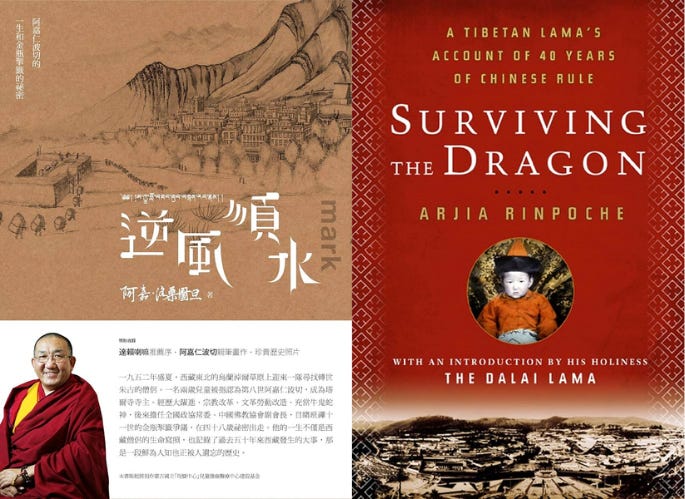
The Chinese authorities then organized their own selection process, claiming to use the Golden Urn. According to eyewitness accounts, the drawing itself was manipulated by physically altering the lots to predetermine the outcome. One of the witnesses was the senior Tibetan lama Arjia Rinpoche, who later described the process in his memoir. He now lives in the Washington, D.C. area. In other words, the Chinese government appropriated the concept of the Golden Urn while fundamentally undermining its legitimacy.
Finally, there is an obvious contradiction. The Chinese Communist Party is officially atheist and does not profess belief in any religion. His Holiness has responded with characteristic wit: if the Chinese government truly wishes to oversee reincarnations, it should first study Tibetan Buddhism and understand what reincarnation actually means. The institution of reincarnate lamas is a uniquely Tibetan Buddhist tradition with a history of more than nine centuries, dating back to the First Dalai Lama. Perhaps, he joked, the government should first identify the reincarnations of Mao Zedong, Deng Xiaoping—and now even Jiang Zemin—before concerning itself with that of the Dalai Lama.
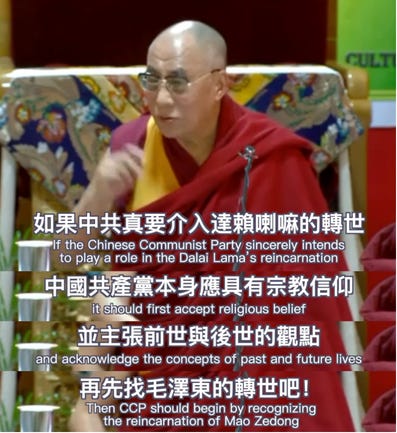
There is an additional irony. The Chinese government has long required Tibetan monasteries to display portraits of successive Chinese leaders—from Mao Zedong and Deng Xiaoping to Jiang Zemin and Xi Jinping—with their names even rendered in Tibetan script. In that sense, one might say the government has cultivated its own form of political personality worship while claiming authority over a religious tradition in which it does not itself profess belief.
We are working in the United States and across the free world. Tibet is genuinely bipartisan in Washington — when Republicans and Democrats cannot agree on anything else, they stand together on Tibet. We do the same in Canada, in India (All-Party Parliamentary Group for Tibet), and everywhere we operate. We will keep doing this work — and keep reaching the next generation, which is why evenings like tonight matter so much to us.
I also want to thank Ambassador Donald Lu. For nearly three decades, he has worked on Tibet-related issues with remarkable personal commitment, and he has been a close partner of ours throughout that time. The current Representative of the Tibet Office previously spoke here at Georgetown at Ambassador Lu’s invitation. Thank you for your time and attention. I apologize — I can speak for hours.
Questions & Answers
【Moderator】
Tibet is an emotional topic in many parts of the world, including the United States. A reminder: let’s be respectful to one another and to our guest.
【Question 1】
I thought it was interesting that you mentioned narratives. One common Chinese narrative is that China invaded Tibet to liberate the Tibetan people from serfdom. What is your take on that?
【Sikyong Penpa Tsring】
China always uses nice words to cover up its misdeeds. They say they “liberated” Tibet — from whom? They invoke slavery, serfdom, servitude. Professor Lao, who researched this extensively in Chinese historical documents, found no record of a slave system in Tibet — but did find records of slave systems in Manchuria and Mongolia.
When China says Tibet was a slave system, they make it sound like medieval Europe. That is not the case. We did have a system of estate owners and associated farmers — a form of serfdom — but no worse than in medieval Europe, and considerably better than in contemporary China of the same period.
“Liberation” is simply another name for “occupation” when used by the Chinese government. We never asked China to liberate us. It was not their job. That is the narrative China tries to impose on the world — that they freed Tibet from slavery. It is not the truth.
「西藏农奴制」中共民族宣传叙事里的弥天大谎 Serfdom in Tibet|The Greatest Lie in ethnic propaganda narrative fabricated by CCP

中共将每年3月28日定为“西藏百万农奴解放纪念日”,用作政治宣传的工具,并强迫境内藏人举行庆祝活动。许多藏人认为,这一纪念日正是针对流亡藏人每年3月10日纪念的“西藏抗暴日”而设立的。
【Question 2】
Given Tibet's strategic importance to China, it seems very unlikely that the PRC will relinquish control. What is a realistic vision for your approach?
【Sikyong Penpa Tsring】
That is precisely why His Holiness is asking for the Middle Way — not independence. If Tibet remains part of China, China will have to reach an agreement with us on how we use our natural resources. His Holiness is not seeking independence — that must be made clear to the Chinese people.
The Chinese government keeps calling His Holiness a “separatist,” but he is not asking for independence. And Beijing has not made that clear to ordinary Chinese citizens — otherwise, the 250 to 300 million Chinese Buddhists would offer much more support for the Tibetan people. Many Chinese come to Tibet as tourists to learn about Tibetan Buddhism; they live in a spiritual vacuum and look to Tibet for guidance.
We are proposing a mutually beneficial solution: Tibet can benefit from China’s economic development, and China can benefit spiritually from Tibetan civilization. Environmental protection in Tibet is critical even for Chinese people. We are on the same page on substance — it is only the Chinese leadership that lacks the wisdom to resolve this.
【Question 3】
Have you ever disagreed with His Holiness, and how have you navigated that?
【Sikyong Penpa Tsring】
Yes, there are Tibetans who disagree with His Holiness — quite a number of young Tibetans seek complete independence. I understand completely: when I was younger, I too sought Tibetan independence. But once you understand global politics, geopolitics, and our constraints, the calculus shifts.
Every time His Holiness says something, he has thought it through many times. We, too, must think carefully, analyze, and then agree or disagree. I tend to agree with His Holiness because he is the most reasonable person in the world. He is always looking for peace and happiness for everyone, not just for Tibetans.
【Follow-up Question】
Do you think the Chinese are afraid that, once His Holiness passes, the idea of the Middle Way may pass with him, and younger Tibetans will push for independence instead?
【Sikyong Penpa Tsring】
We hope His Holiness lives for a very long time. But that concern is exactly why our current strategy focuses on Tibetan history — to reopen doors and windows that have been closed. You never know what can shift.
One of our planned initiatives is to study different scenarios for China — with external forces and under various political conditions — and, under each scenario, assess the challenges and opportunities for Tibetans and Tibet. These are the things we will keep doing, unless and until some common sense enters the Chinese leadership.
Compiled and Edited by GD; Translated by Wilson
Special thanks to Hoyas for Human Rights (Georgetown University), the Office of Tibet in DC, and everyone who made this event possible!