

This article is an excerpt from The New York Times’ interview with journalist Jianglin. Author: Edward Wong.
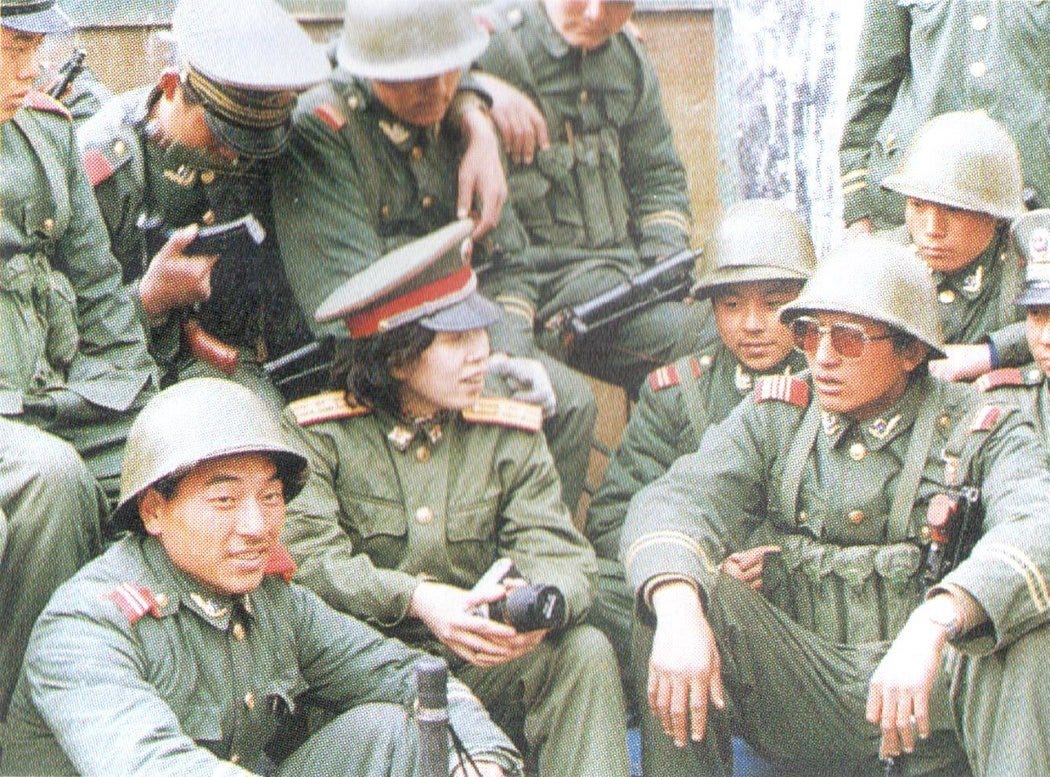
March 1989: Martial Law in Lhasa
Q: A few months prior to June 4th, as a journalist for the People’s Liberation Army Daily (PLA Daily), you boarded a military plane packed with soldiers and traveled to Lhasa. At the time, the Chinese government had imposed martial law to suppress demonstrations by Tibetans. What did you learn in Lhasa?
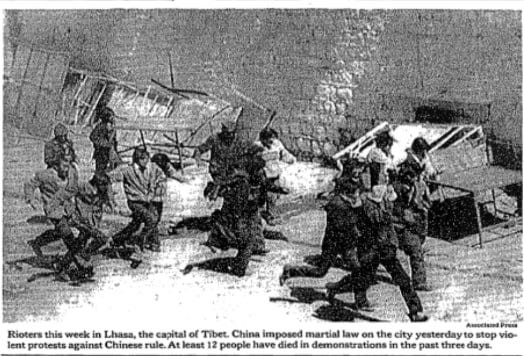
A: On March 8, 1989, I learned about the martial law in Lhasa from the news broadcast on China National Radio. On the 9th, I took the first plane deployed for the martial law operation to Chengdu, and then flew to Lhasa with the first batch of soldiers. At that time, the entire city of Lhasa was in chaos. Lhasa is very small; its center is just the Potala Palace and the Barkhor Street area. There were burned-down shops everywhere. The task assigned to me by the newspaper was not to report publicly, but to write “internal reference” reports (neican).
I didn’t understand at the time why several protests in Tibet were defined as riots, and specifically as monks rebelling. In my imagination back then, monks in monasteries were all very quiet, just sitting there chanting scriptures and such—how could they take to the streets to rebel? I saw some internal materials stating that they were waving the Snow Lion flag and demanding Tibetan independence.
During my time there, I interviewed the chief of the Lhasa Public Security Bureau. I asked him why there was a need for martial law. The Lhasa police chief said, “There is absolutely no need for you guys to be here.” I asked why. “Isn’t it because you couldn’t handle it yourselves that the army needed to come in?” He said, “Nonsense! Lhasa is such a small place; I know almost all of those troublemakers. What kind of police chief would I be if I couldn’t handle them?” To prove this, he even took me to the prison to demonstrate face-to-face his close familiarity with those inmates.
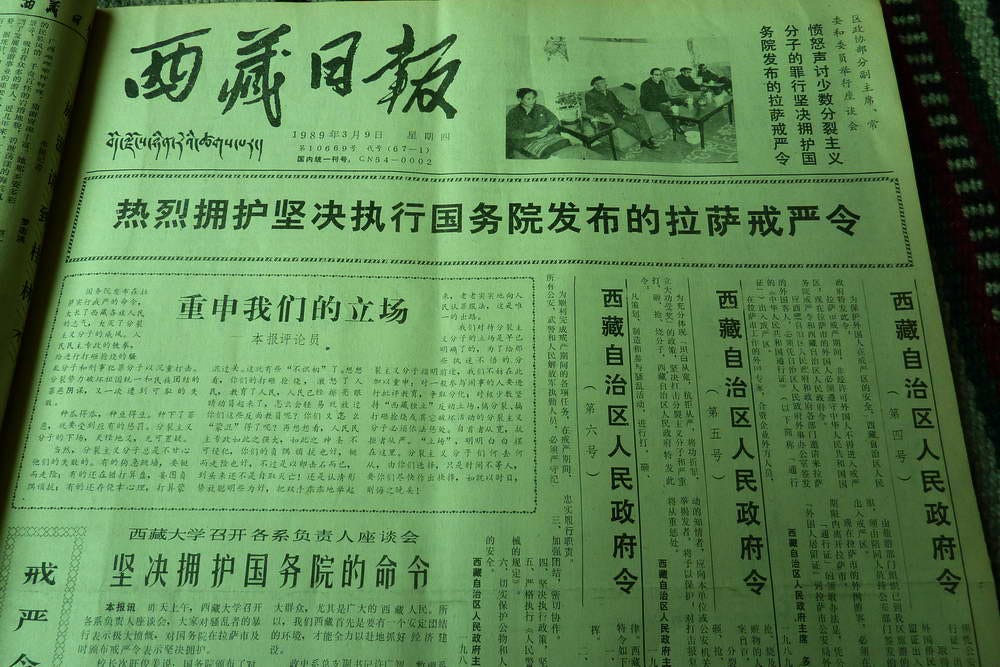
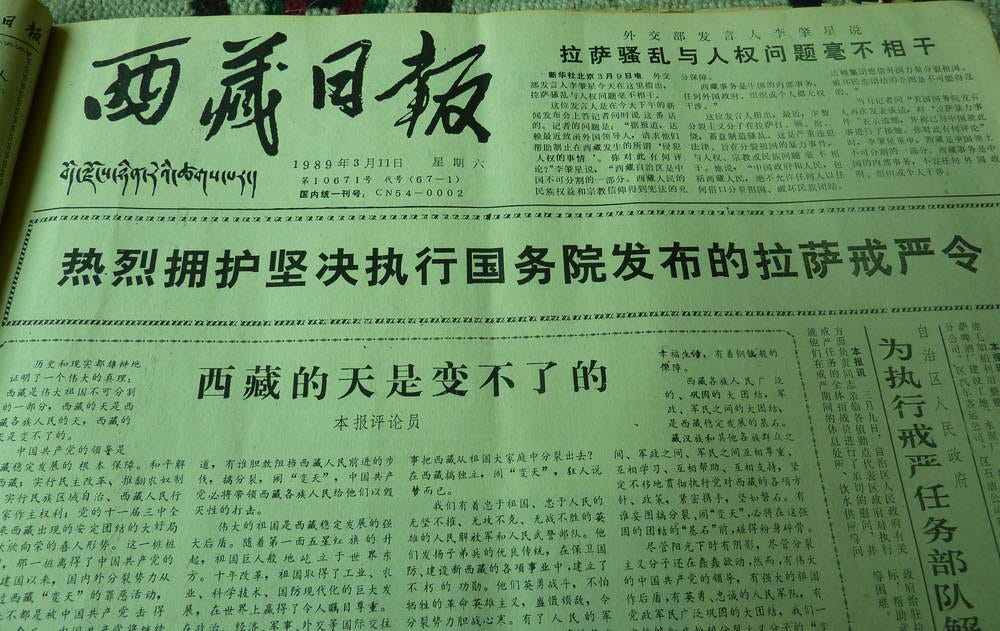
He said that at the time, they just watched as those people set fire to Barkhor Street, burning down the shops one by one, because the shops on Barkhor Street were all run by Han Chinese. After the “reform and opening up,” first people from the Chengdu area, and then carpenters from the Zhejiang area, came to Lhasa, primarily to sell electronics and make traditional Tibetan cabinets. Their businesses were booming more than the Tibetans’, and the Tibetan cabinets they crafted were even more beautiful than those made by the Tibetans themselves. Consequently, these Tibetans felt that the outsiders had stolen their livelihoods, and they resented them. They took advantage of the unrest to burn down their shops.
Logically speaking, this constitutes criminal behavior—how can you just burn down someone else’s shop? But the orders the police received were that no one was allowed to take action. Forbidden from acting, they could only watch as these people committed arson, burning down the shops one by one until they were all gone. The fire eventually reached the Barkhor Street police station, where he was stationed, completely surrounding them. Finally, left with no other choice—since they couldn’t just wait to die—he ordered a police officer to ram a motorcycle through the wall to smash a hole, and they escaped through that opening.
I also interviewed the commander of the Tibet Military District. The commander told me that when Barkhor Street was on fire, the troops had already assembled. At that time, it was the Armed Police, sitting in their trucks, but no one was allowed to act. What were they waiting for? They were waiting for orders from the central government. In reality, the Tibet Autonomous Region has no autonomous power. Once this reality was established, the central government ordered martial law. When the Armed Police troops finally charged into Barkhor Street, they simply opened fire, killing and injuring many innocent merchants and pilgrims. After martial law was imposed, the prisons were filled to capacity with arrested individuals.
At the time, the Party Secretary of the Autonomous Region was Hu Jintao. When the main martial law forces arrived, Lhasa welcomed the People’s Liberation Army entering the city. I was standing right next to Hu Jintao, but I don’t know where he was when Barkhor Street was being burned; I never asked him.
Q: What was your conclusion at the time? And how did that experience influence your view of the official handling of the demonstrations in Beijing?
A: At the time, we were just trying to understand the reactions of various sectors in Lhasa to the martial law, and everyone believed it was unnecessary. It was a waste of manpower and resources. They were asking, “Why did you even have to come?” Furthermore, having killed and injured innocent people, how were they going to face them in the future? I went to the hospital for interviews, and the medical staff were in tears as they spoke: “To build Tibet, we have dedicated our youth and our descendants. With martial law and the opening of fire, shooting them up like this, how are we supposed to live here in the future?”
A comrade-in-arms of my sister from her time in the military had a father who was the Director of Operations for the Tibet Military District, having entered Tibet with Zhang Guohua in 1950. I consulted him, and he brought up the issue of corruption to me for the very first time; I had never heard anyone talk about it like that before. He asked me, “What does the current Tibet Military District commander’s office look like?” I replied, “The office floor is covered with khaden (traditional Tibetan woven carpets) all the way into the bathroom.” He said, “How corrupt! Back in the day, Zhang Guohua’s office was just a single desk, a wooden bed, and a wooden chair. His relationship with the Tibetans was excellent. That relationship has been completely destroyed. Now, their relationship with the common people and the Tibetans has deteriorated to the point where they can only deal with them using guns.”
I sent five “internal reference” reports (neican) to the newspaper regarding the situations I had uncovered. They were all focused on the problems, touching on Tibet’s ethnic and religious policies and attitudes toward martial law. A few people from the Xinhua News Agency’s military branch who had traveled with us—reporters stationed in Chengdu—claimed they had been to Tibet countless times and were already very familiar with it, so they just stayed inside the military district compound, chatting with the leaders.
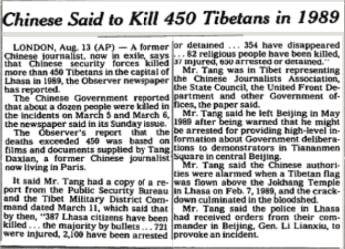
Their conclusion was that this martial law was absolutely necessary. They argued that the suppression of the 1959 rebellion had guaranteed 30 years of peace in Tibet, and that the 1989 martial law would secure another 30 years of peace. I told them, “That is a fallacy.” He replied that relying on military force and violence was the only way to make them submit.
He asked me why it was a fallacy. I explained that in 1959, the regime was unstable, and the Tibetan army had guns; you could use armed force to counter their armed force. But 30 years later, these Tibetan civilians are unarmed, and your regime has stabilized. You could absolutely rely on the rule of law—the police chief himself said he could have solved the problem.
However, all five of my neican (internal reference reports) were withheld and “killed” [spiked by the editors]. The reason given was bizarre: they said the military should not interfere in politics. I thought to myself: Your army has already been deployed; you are already interfering in politics.
April 1989: Beijing Students Take to the Streets
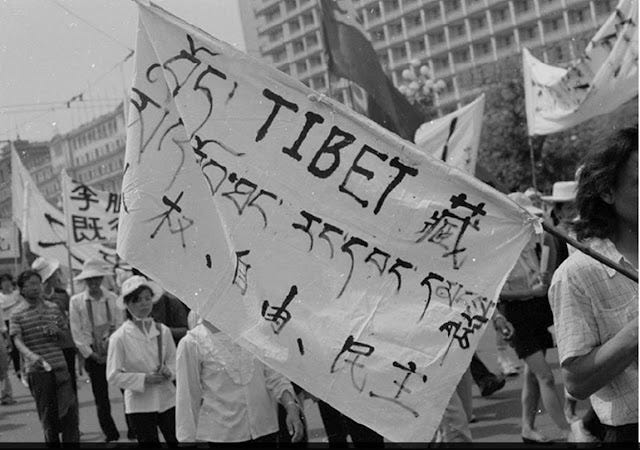
Q: You returned to Beijing in April, just as the student demonstrations were beginning. How did you view the student demonstrations at that time?
A: On my way home, I passed through Tiananmen Square. Our home was over in Huangsi, in the dormitories of the General Political Department.
Passing through Tiananmen Square, I noticed there were so many people. That day happened to be the day Hu Yaobang passed away, and Tiananmen was an absolute sea of people. Furthermore, people said you could go to Hu Yaobang’s house to pay your condolences. His home was very close to Tiananmen, so I followed the crowd there to pay my respects. Later on, when I met Hu Deping [Hu Yaobang’s son], I told him, “This is actually our second time shaking hands.” He asked when the first time was, and I said, “It was when your father passed away; I went to your house, and you shook hands with every single person who came to mourn.” Their family members are all quite approachable and possess a strong connection to the common people.
At that time, I was struck by how many people there could be, and I went back and talked about it with my friends in the General Logistics Department. They asked, “Does it compare to when Zhou Enlai passed away?” I said, “It’s about the same.”
At the time, I actually disapproved of and didn’t really agree with the students taking to the streets. Why? Because Hu Yaobang’s forced resignation stemmed from the earlier campaign against “bourgeois liberalization,” it was the students who took to the streets back then who ultimately led to his downfall.
Therefore, I remember saying during a discussion meeting at the General Logistics Department that people like Hu Yaobang and Zhao Ziyang were among the very few remaining, highly exceptional leaders within the Communist Party who possessed an open-minded awareness. After 1949, there were endless political campaigns, followed by the Cultural Revolution. The relentless waves of these movements constantly sifted through the Communist Party cadres, and many people died during them. The fact that these men managed to survive and still maintain an open-minded perspective meant such leaders were exceedingly rare. We should protect them and cooperate with them, rather than oppose them. I argued that the ultimate result would simply be to force them out of power, which is exactly what happened to Hu Yaobang in 1987.
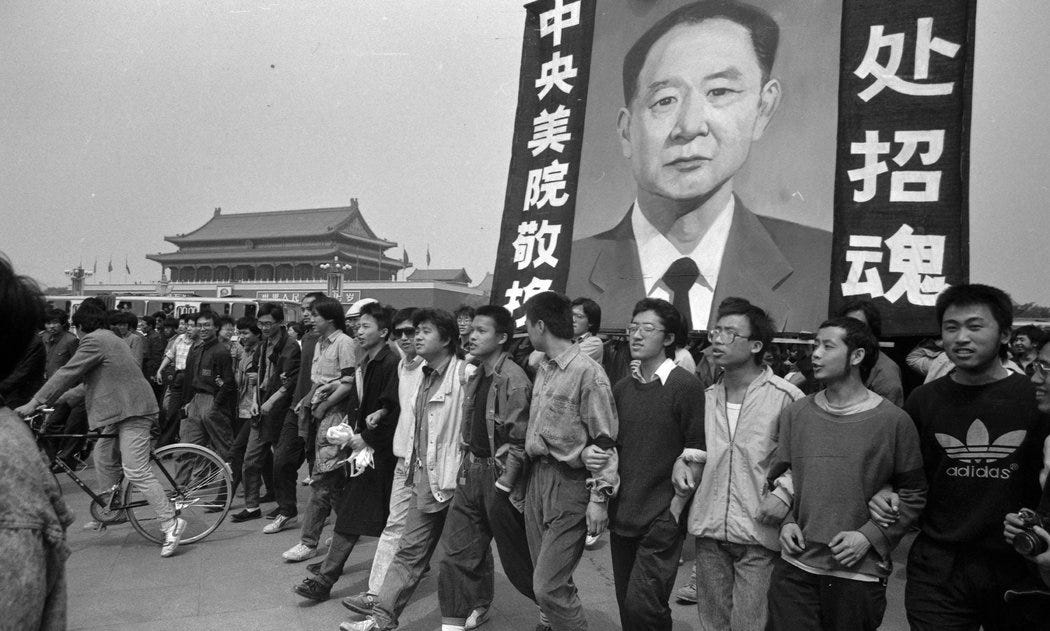
The students’ protests lasted for a long time. One weekend, when it was time to head home again, I witnessed several military vehicles of the 38th Army being blocked in Tiananmen Square. This was not yet “June 4th,” and I didn’t know what mission they were on. They were surrounded, layer upon layer, by students and citizens who told them to go back, saying that Beijing didn’t need them. I felt that these soldiers were in a very awkward position.
Returning from Tibet, I remembered that in Lhasa, it was the Armed Police who opened fire, not the People’s Liberation Army. The ordinary citizens had welcomed the army into the city, feeling that soldiers and the Armed Police were different: the Armed Police shoot at us, while the soldiers come in to protect us. Furthermore, I felt that the military’s mission is external—to resist foreign aggression—not to deal with common citizens; internal affairs should be handled by the Armed Police and the regular police.
Later, feeling indignant about it, I went straight to the newspaper office, found my boss, Qian Gang, and asked him if I should write an internal reference report (neican). He asked what it would be about. I said I wanted to suggest that the military should not intervene in local governmental affairs. If they absolutely had to participate, the soldiers carrying out the orders should change into Armed Police uniforms. Otherwise, it would be hard to play your cards in the future. It’s just like playing cards: if you play the big joker right from the start, you’ll have no cards left to play.
May 1989: Martial Law in Beijing
Q: Where were you when the State Council announced martial law? What was your reaction?
A: I was in Beijing. I disapproved of it at the time, because I had just come back from Lhasa and because I saw the overall situation. The students were maintaining excellent order during the protests themselves, and there were no incidents of beating, smashing, or looting in Beijing. The social order in Beijing was surprisingly good those few days—even the thieves went on strike. So, I didn’t feel there was any need for it. Moreover, the conclusion we reached in Lhasa was that it was unnecessary.
Q: After martial law was announced, based on your experience in Lhasa, did it ever cross your mind that they would open fire?
A: I never thought they would, because at that time, we still held high expectations for the military and the government. We felt they wouldn’t do something so outrageous.
Original:纽约时报|前军官谈“六四”:派军队清场,就不好再出牌了
References:唯色 | 1989年:消失的3月10日,以及《六月某时》