

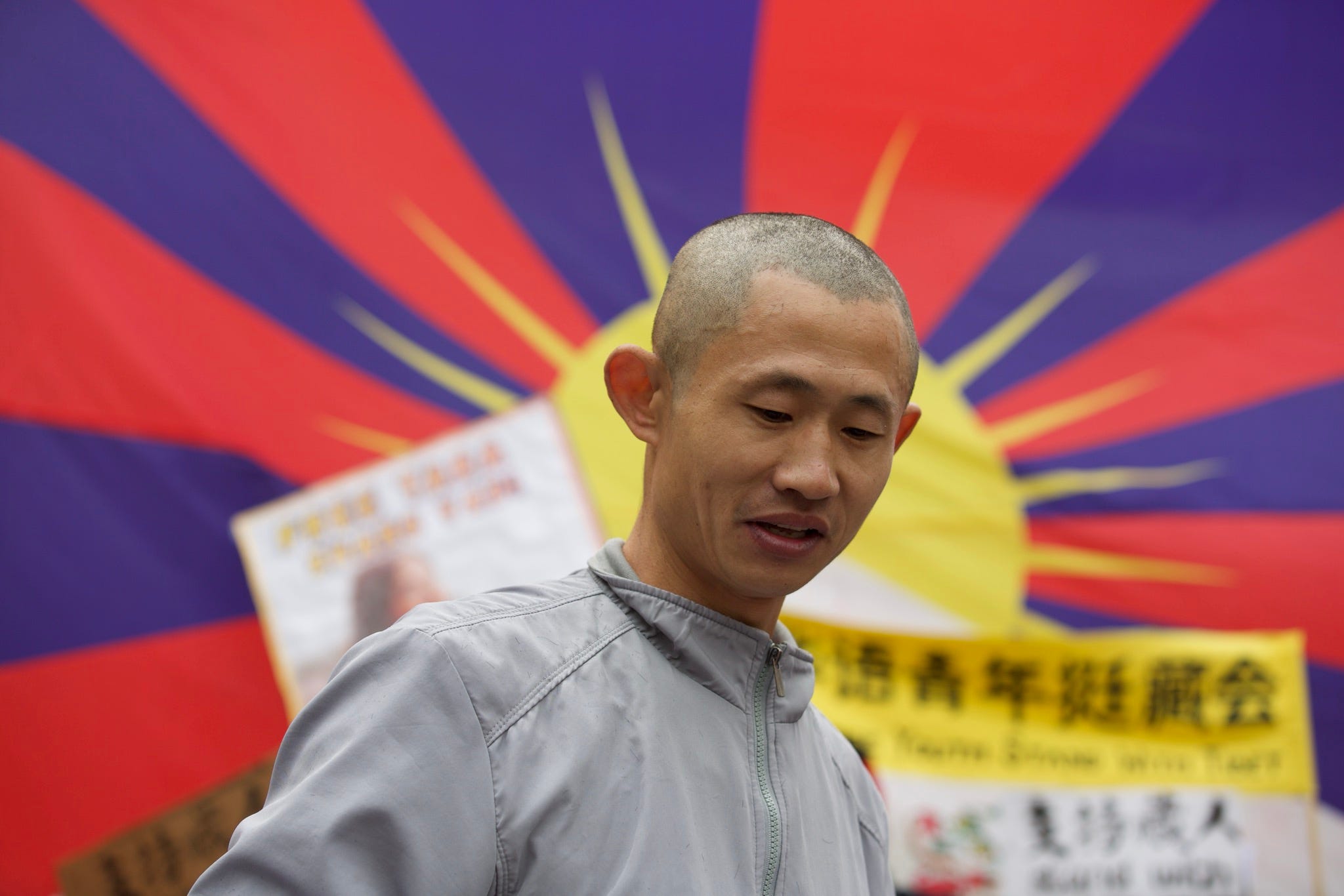
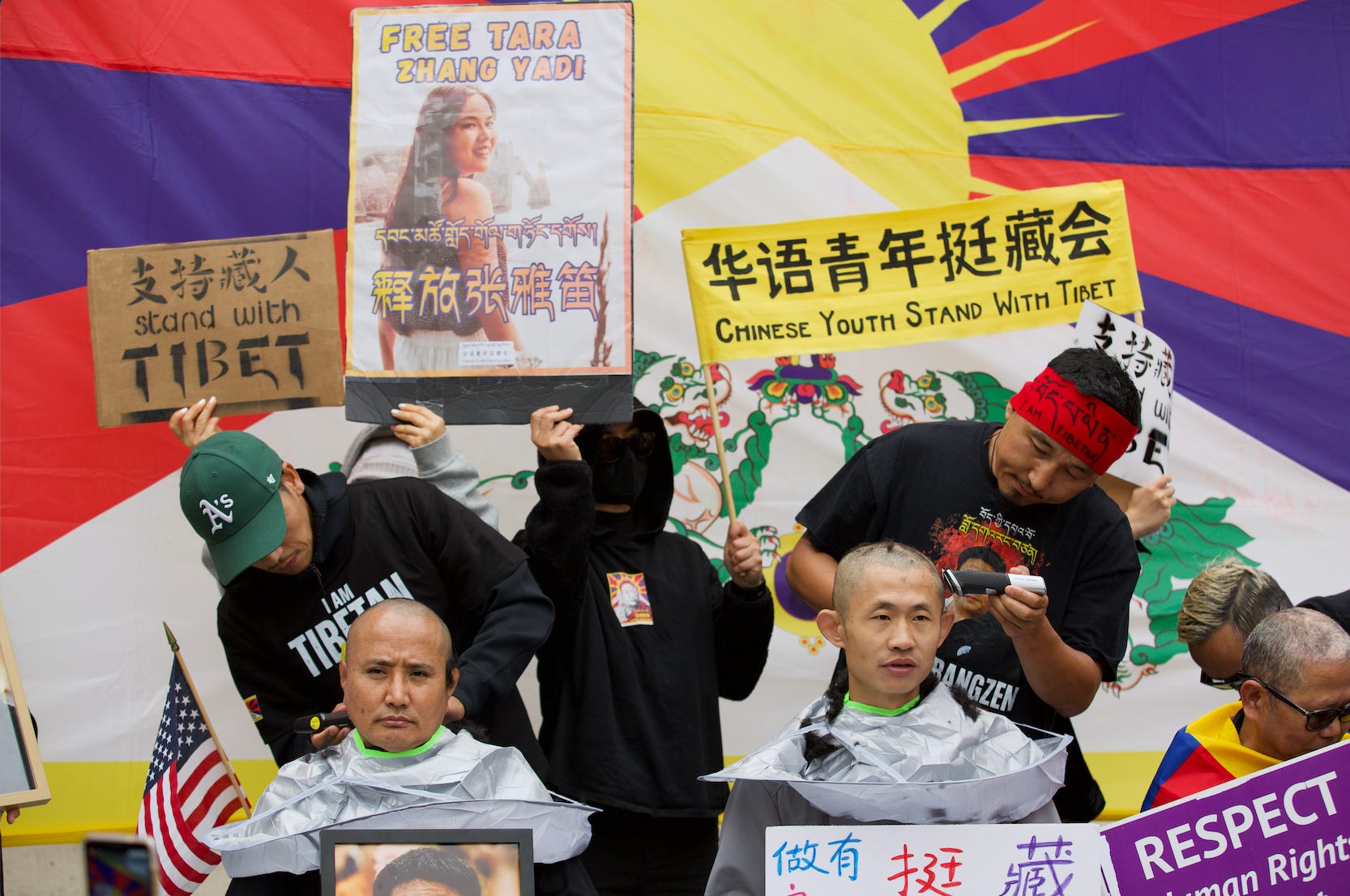
At a rally outside the Chinese Consulate in San Francisco commemorating the Tibetan hero Loga Rangzen, a young Han Chinese man shaved his head in public. His name is Sheng Hu. Originally from Kaifeng, Henan Province, he is in his30s and worked as a factory worker in China. He arrived in the United States less than two years ago and now washes dishes and does odd jobs at a Chinese restaurant in San Jose.
That day, he asked his boss for 2 hours off and drove from San Jose to San Francisco. As soon as the rally ended, he returned to work washing dishes.
After he shaved his head, insults poured in online. Some called him a “traitor to the Han people.” Others called him a “descendant of slave owners.” Still others insisted that he “couldn’t speak a word of Chinese.” Why would an ordinary Han Chinese man shave his head for Tibetans? Lhasa Spring sat down with him for an extended conversation.
Watch the interview in mandarin
The following interview has been edited and abridged. Questions are from Lhasa Spring; answers are from Sheng Hu.
“In China, I Knew Next to Nothing About Tibet”
Q: When you lived in China, how much did you know about Tibet?
Sheng: Very little. You could say I knew next to nothing. Most of what I knew came from the evening news: the Tibetan people had been liberated, freed from the so-called serfdom system, and were all living good lives. Then there were the Chinese Communist Party’s overseas propaganda videos and foreign influencers interviewing Tibetans, showing spotless homes and spotless monasteries.
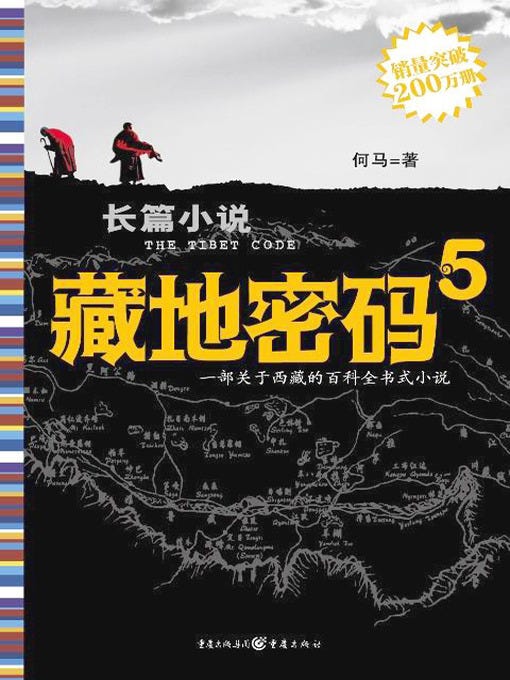
What taught me more was a novel, The Tibet Code, by He Ma. The author said he had consulted more than three hundred books. It covered everything from the Tibetan Empire during the Tang dynasty to the period before the exile—religion, geography, groundwater resources, every detail. It seemed like an encyclopedia of Tibet. After that, Tibet became a place of mystery in my mind.
Q: What other things did you hear online?
Sheng: The most common claim was that “Tibetans don’t bathe”—that they bathe only twice in their lives, once when they get married and once on another occasion. People also said they wore the same Tibetan robe all year without changing it, and that the strong ultraviolet radiation made their skin dark with a reddish hue. The image promoted by the Communist Party was basically a little girl with dark skin, wearing a worn-out Tibetan robe and herding sheep on an endless grassland.
As for Tibetan independence, all people knew was this: the Dalai Lama represented the government-in-exile; he was a Tibetan separatist, and he was always trying from abroad to overthrow the CCP and make Tibet independent. That was about the extent of the information we had.
A Turning Point: Why Would a Girl Be Charged with “Inciting separatism”?
Q: What eventually made you start paying attention to Tibet?
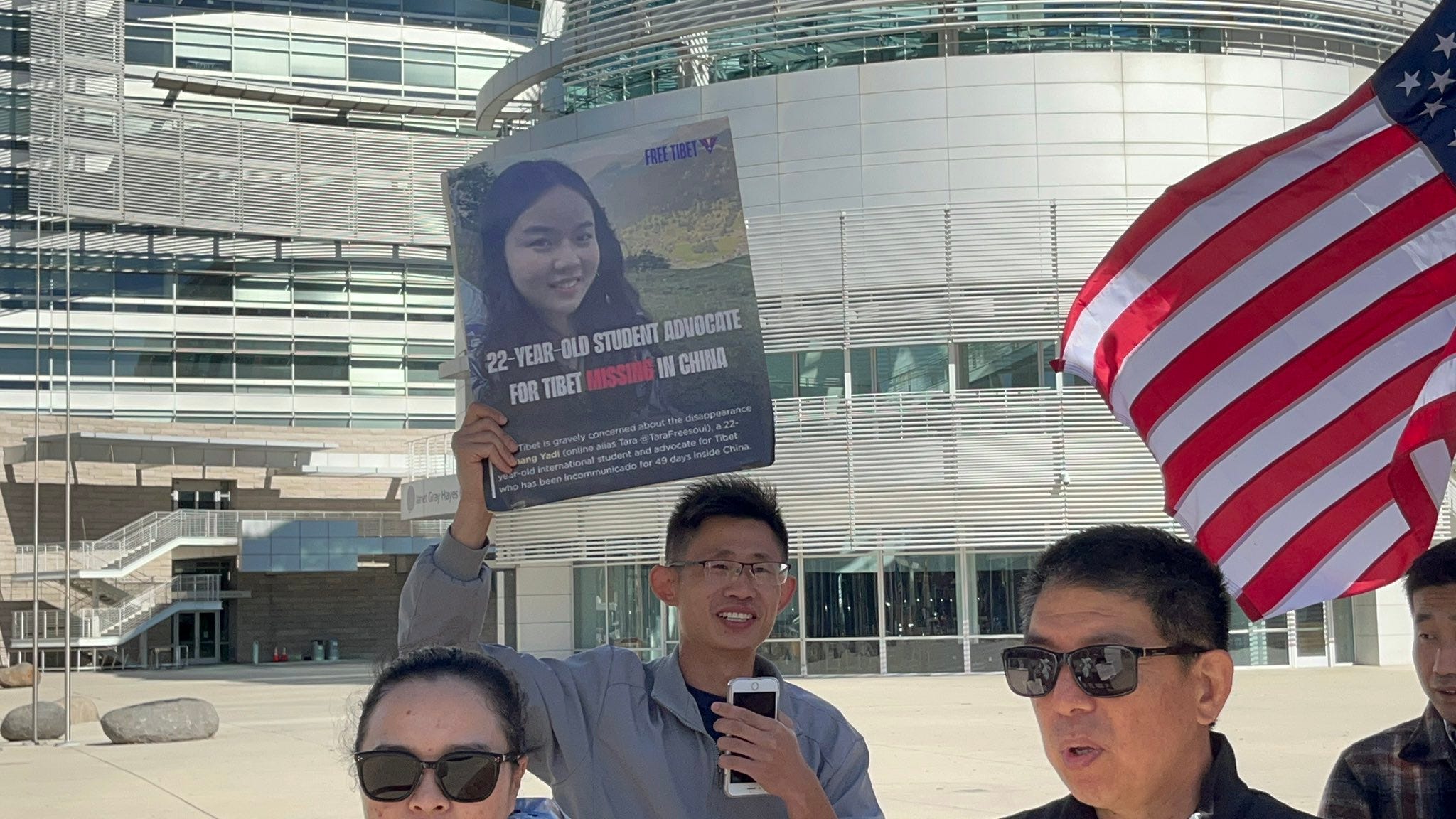
Sheng: It was Zhang Yadi’s case. The first pro-democracy event I ever attended was in support of Zhang Yadi and Peng Lifa, who had called for “We want freedom, not COVID tests.” I happened to be holding a sign for Zhang Yadi that day. Your first time always leaves a strong impression.
I was curious: how could a young woman be charged with “Inciting separatism”? What had she written or said? So I went to her Twitter account and read about her experiences. At first, I only knew she had participated in the White Paper protests on the streets of Paris. Later, I learned that she had worked as an editor for Chinese Youth Stand for Tibet and published articles there. My personal view is that her arrest had more to do with her work at Chinese Youth Stand for Tibet. That was when I really began paying attention to Tibet.

Q: How did you see the Tibet issue at that point?
Sheng: When I first left China, I was like most Han Chinese people. Within the framework of a unified nation, it seemed perfectly natural that we should rule you and that you had no right to resist. Assimilating you, preventing you from speaking your own language, making you speak Mandarin—I didn’t see anything wrong with that. That was what our textbooks had taught us since childhood: Qin Shi Huang unified the six kingdoms, standardized the widths of carriage axles and the written script. (车同轨、书同文) Anyone who expanded the territory was a hero; anyone who lost an inch of land was a traitor.
Q: But China was also invaded by Japan. Had you ever thought about the connection between that and Tibet?
Sheng: Never. Many people in China watch those exaggerated anti-Japanese war dramas and see themselves as victims: Japan invaded us, so we had to resist. But I had never connected that to Tibet.
“If There Had Been Plenty of Han Chinese People, I Wouldn’t Have Shaved My Head”
Q: Few ordinary Han Chinese people are willing to hold signs or chant slogans for Tibetans. Why did you not only attend, but also shave your head?
Sheng: Honestly, I didn’t start out with such a strong intention. Beforehand, I asked you whether many Han Chinese people would be there. If there were plenty, I wasn’t going to take part in the head-shaving. I would just give a speech and express my views.
But when I arrived, apart from me, only one other person from the China Democracy Party was there. There were also members of a Tibet solidarity group, but almost all of them were fully covered up, wearing sunglasses and hiding their faces. Only two of us were willing to appear under our real names and show our faces. I asked the other man whether he wanted to shave his head with me, but he just took some photos to show he had been there and left. Oh, hee was holding a photograph of His Holiness the Dalai Lama.
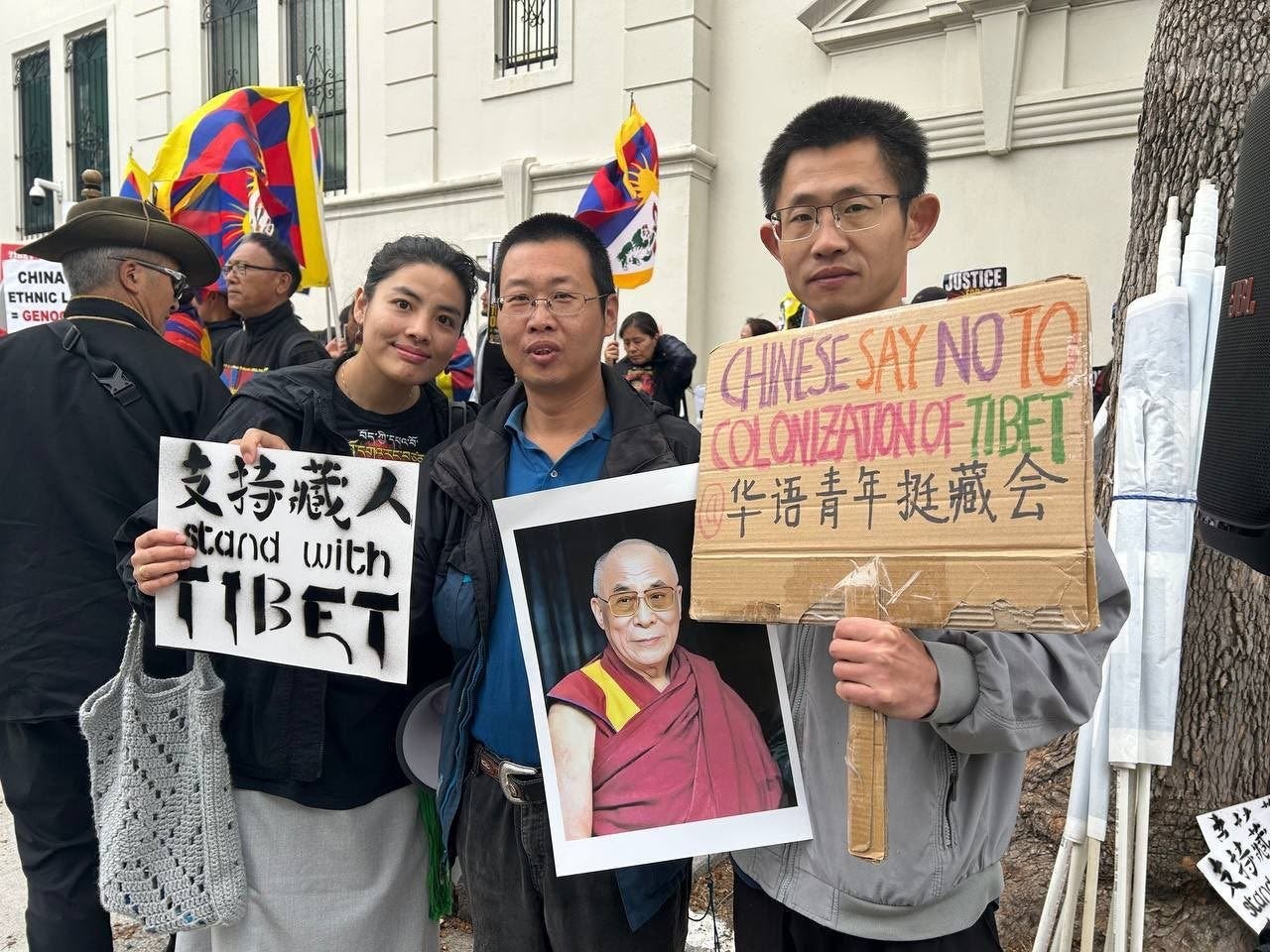
Q: Yeah, I asked him why he had printed that photograph. He said it was mainly because he was afraid Tibetans might see him and hit him, and that holding a picture of His Holiness would make them accept him. Many people gave him a thumbs-up that day and took photos with him.
Sheng: Whatever his motive was, simply thinking of bringing a photograph of His Holiness put him ahead of 95 percent of Han Chinese people. At least I hadn’t thought of doing that myself.
Q: Why?
Sheng: Because everyone knows how sensitive a photograph of His Holiness is. You could curse Xi Jinping a hundred times outside the consulate or hold up a protest sign a hundred times, and perhaps no one would come after you. But once you touch issues like Tibet or Xinjiang, it’s a different story.
“Han Chinese People Really Do Have a Conqueror’s Mindset Toward Tibetans”
Q: Did you have any contact with Tibetans or people from Xinjiang when you lived in China?
Sheng: No. But anyone—even someone who cannot read and has no particular opinions—knows that Xinjiang and Tibet are subjects you must not touch. My parents didn’t even finish primary school. They learned a few characters in literacy classes. But whenever I mentioned going to Tibet for work or travel, they would wave their hands and shake their heads: “Don’t go. And don’t associate with Tibetans.”
When I worked in factories, many places put up recruitment notices saying, “The quota of five ethnic minority workers has been filled.” They put up the sign before they had even started hiring. These are things I experienced firsthand during more than 30 years of living in China.


Q: How do you see Han Chinese attitudes toward Tibetans?
Sheng: Honestly, Han Chinese people really do have a conqueror’s mindset toward Tibetans, including ordinary people. You are the conquered. You will forever be part of my country’s territory. You deserve whatever happens to you. I can treat you however I want because I have already conquered you. Many people just don’t say it as openly as I do.
Take the unrest in Xinjiang. Many people treated it as casual conversation: “See? Those people in Xinjiang just needed to be put in their place. They’re not making trouble anymore, are they?” That is Han chauvinism.
Q: So you understand why Tibetans are distrustful?
Sheng: Completely. I understand why Tibetans distrust Han Chinese people, why they don’t want to speak Chinese and see it as the language of an invader, and why many do not accept the Middle Way Approach. They feel that no matter who comes to power—even so-called democracy advocates—they will still be in the position of the conquered. I want to tell them: you are right in your assessment.
I don’t support secession, but apart from that, I deeply understand, support, and respect everything they do. Their understanding is accurate. It does not come from hatred.
Unable to Return Home
Q: You don’t know much about Tibet. Why were you still so determined to shave your head and show your support?
Sheng: I want to test what I think I know through real contact, instead of relying only on the media and books. I wanted to get closer to them, but most of them didn’t speak Chinese. I could only try to connect through their songs and sing along with everyone. That day, I wrote four Chinese characters: “Unable to return home. 故土难回 ”
Sheng: I’ve always felt that, whether we are talking about the Middle Way or independence, neither matters more than exiled Tibetans being able to return to their homeland. I have a very naïve dream: if President Trump could help arrange for His Holiness the Dalai Lama to take some people back to China—even for just seven or ten days—to return to Tibet itself, with each person taking a handful of soil or filling a bottle with water, I think that would answer the deepest longing in the heart of every Tibetan in exile.
The authorities could have state security officers accompany them the whole time, and even bring along foreign journalists. His Holiness is a very wise person. He would not say anything that crossed the Communist Party’s red lines, and he wouldn’t need to. All he would have to do is stand on that land and cup some water from his homeland in his hands. That one image would be enough. I believe it could only benefit the CCP’s governance of Tibet.
Q: Why do you think returning to that land matters so much?
Sheng: In my limited understanding, Tibet is a very special place. Only in such a distinctive environment could such a unique religious tradition and cultural heritage have developed. Once removed from that soil, it will die, like a transplanted plant.
“Atoning on Behalf of Han Chinese People”
Q: What did your friends think about you shaving your head?
Sheng: They didn’t understand. Some joked, just like people online, that I was trying to save money on haircuts. Even many of my friends who also oppose the CCP—I don’t think they understood either.
Q: What was your deepest motivation?
Sheng: I finally remembered what I most wanted to express that day but never managed to say. I don’t want to speak for all Han Chinese people, but I think what Tibetans say about us—or what you might call “original sin”—is real. As a Han Chinese person, I wanted to express a feeling of atonement on behalf of Han Chinese people, to say to Tibetans: we are sorry.
I am a Christian, and I acknowledge that I am a sinner. Perhaps that is why I approach this more from the perspective of atonement. Even if people call me a traitor to the Han people, I have done what I most wanted to do. Through these actions, I hope to awaken more Han Chinese people to the Tibet issue, and to show friends in Tibetan areas inside China that we can speak out courageously against injustice.
Q: Why do you think influencing Han Chinese people is so important?
Sheng: Tibetan friends are often reluctant to associate with Han Chinese people. They want to achieve their goals on their own, whether that means independence or the Middle Way. In my view, that is not realistic. Whether or not the Communist Party falls, this country will ultimately be dominated by Han Chinese people. Officials will grow old, and the next generation of police chiefs will come from the younger generation of Han Chinese people. They won’t be Uyghurs, much less Tibetans or Mongols. Whether you agree with it or not, that is the reality.
So awakening more Han Chinese people, helping them break free of the CCP’s narrative and truly understand Tibetans’ experiences and circumstances—that is the foundation for a lasting resolution of the Tibet issue.
The Middle Way and Dialogue Overseas
Q: What is your own position?
Sheng: I have never advocated independence for any ethnic group. I strongly agree with His Holiness the Dalai Lama’s Middle Way Approach. I think it is relatively feasible, and I hope Tibetan friends can embrace it wholeheartedly.
Inside China, this kind of dialogue is the most forbidden of forbidden subjects. It simply cannot happen. The one thing we can do overseas is begin building common ground: Tibetan friends can share their advanced experience in organizing and communications, and build greater solidarity with so-called dissidents and democracy advocates. It is like the two-track approach proposed by Wang Dan: dialogue with those in power, alongside dialogue with dissidents and democracy advocates overseas. I think that could serve as a model.
Sheng: One last thing I want to share is some people challenge me. “If Tibet becomes independent, would you want to take South Tibet back from India?” The government-in-exile relies heavily on India’s support, so that is indeed a difficult question. But my view is that even if Tibet became a country, it would not be able to reclaim South Tibet. It would only become harder; it might not even be able to raise the issue. Of course, I could be wrong.
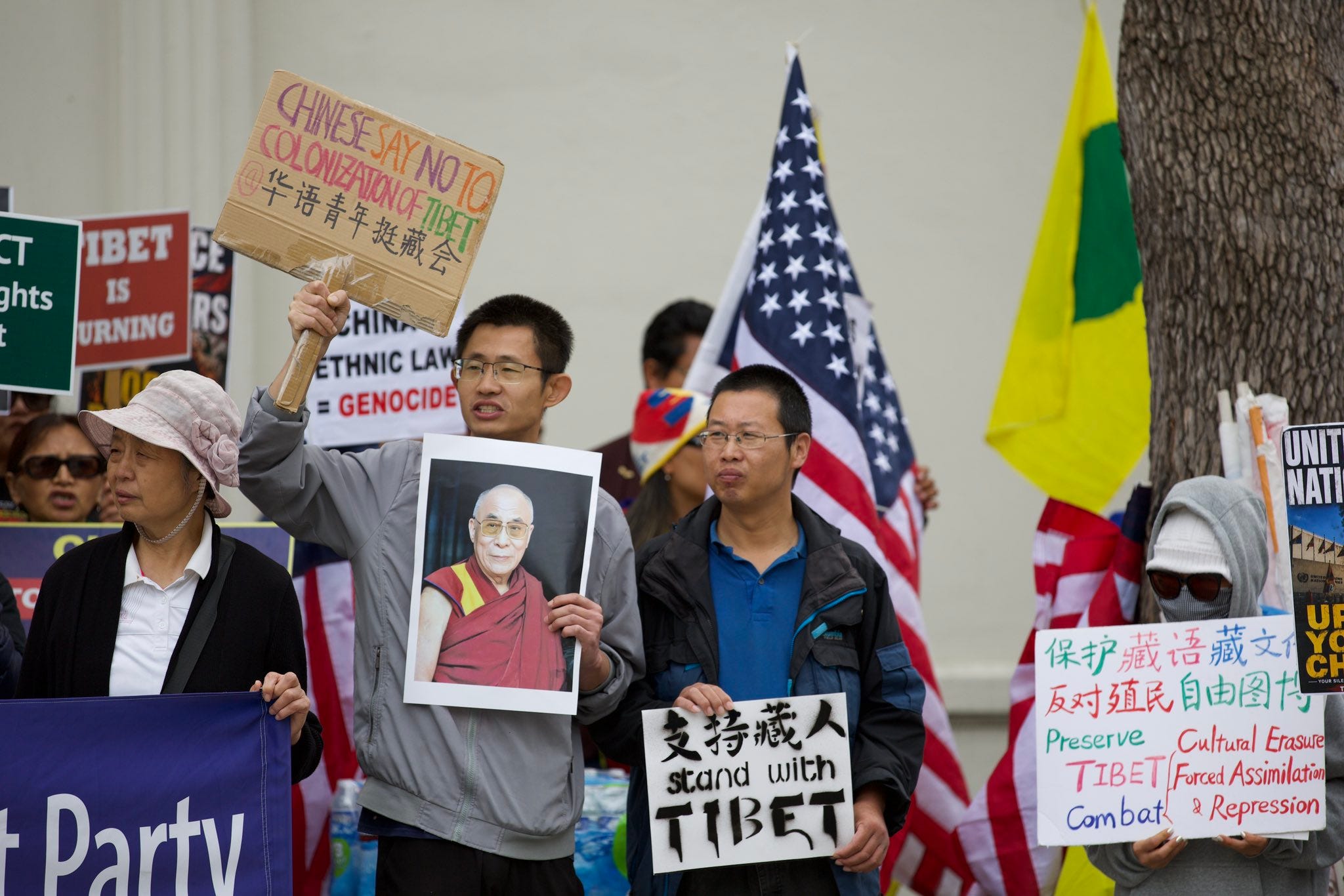
That day, Sheng Hu had prepared a speech. But because most of the Tibetan present could not understand Chinese, and he himself could not speak English, he ultimately did not deliver it. After facing attacks online, he decided to revise the speech and publish it, hoping Tibetan friends would come to know him as he really is.
In it, he wrote:
“True strength has never come from erasing other peoples’ languages, faiths, or the ways of life they choose for themselves. Nor does true unity come from fear and assimilation.”
His speech ended with these words:
“Though a firefly’s light is faint, it dares to shine alongside the radiant moon.”
Producer:Ginger Duan

