

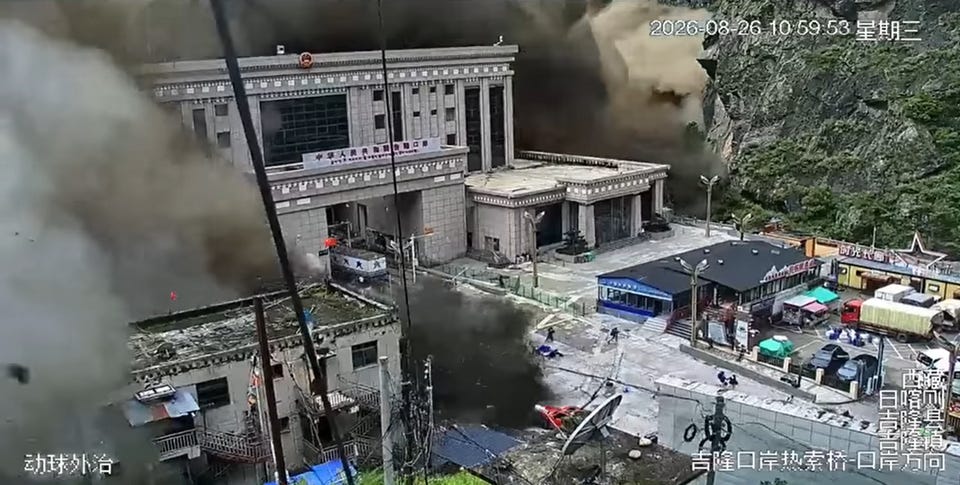
On the early morning of August 26, deep in the Himalayas, a glacier fractured and plunged into the valley below, releasing energy equivalent to a magnitude-5.2 earthquake. Ice, rock, and meltwater crashed from the heights into the river valley, rapidly churning up sediment and boulders until it became a nearly unstoppable black torrent.
The torrent raced nearly 100 kilometers down the existing river channel toward the Tibet–Nepal border, burying the five-story customs building at Gyirong Port. The entire town of Gyirong was wiped off the map.
Before search and rescue had even ended, Party media had already given the disaster an uplifting theme. They turned the five characters “I love you, China” left on a mountainside into a symbol of the Chinese people’s “ambition, backbone, and confidence.” They planted the national flag on the ruins of the border gate at Gyirong Port. The red flag on the rubble became the center of the coverage; the people buried beneath the rubble and mud were nowhere to be seen.
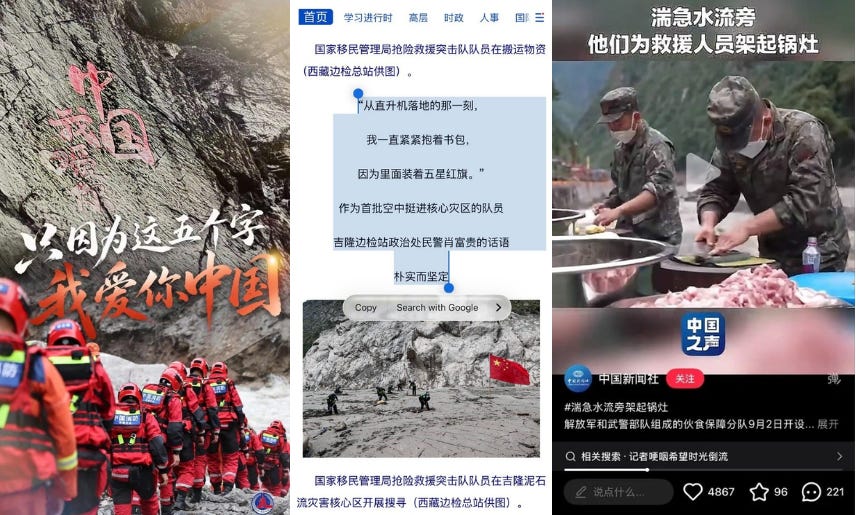
Online, this shaping of the disaster’s meaning followed explicit political deployment. On September 1, Wang Junzheng, Party Secretary of the “Tibet Autonomous Region,” while directing rescue operations at the region’s emergency command center and stability-maintenance command center, stressed the need to “firmly grasp the initiative in public opinion work,” treating it as important than the rescue itself. As of September 7, the Chinese side had confirmed 43 dead and 519 missing on the Tibetan side, yet had published no list of the missing, the dead, or the rescued. In the eyes of the Party’s propaganda apparatus, guiding the public to be moved by patriotic symbols, to marvel at post-disaster resilience, to feel grateful for the Party’s rescue — even to watch how meals get cooked on the ruins — matters more than answering the anguish of the families of the missing.
Meanwhile, in the CCP’s telling, the mudslide is reduced to a purely natural disaster that originated on the Nepali side; Chinese state power appears only in the role of rescuer, while pre-disaster warnings, siting decisions, and the responsibilities of development are brushed aside in a single stroke.
Nature decides when the torrent comes. Policy decides whether people are standing in its path when it arrives.
Nature reported on September 2 that analysis of pre-disaster satellite imagery showed the ice-rock mass that collapsed had been visibly accelerating in the days before the event. Nor was this the first time danger had shown itself.
People working at Gyirong Port sensed it too. Yang Shizi, a 26-year-old border police officer, wrote to a friend in May 2026 with astonishing foresight of the disaster: “Every night I fall asleep to the surge of the river. Sometimes, when the rain lasts all night and the mountains roar and the valleys answer, I find myself thinking that perhaps one day a disaster will come, and I will sleep here forever.” He was from Yunnan; after university he passed the civil service exam and had only just taken up his post at Gyirong Port. He remains missing to this day.
In July 2025, Gyirong Port had already been through a similar disaster. A supraglacial lake that no standard inventory had identified suddenly drained; the flood destroyed the China–Nepal Friendship Bridge at the port and killed 11 people. Gyirong Port was closed from July 2025 until January 2026. It had been reopened for barely a few months when this August’s disaster destroyed it completely.
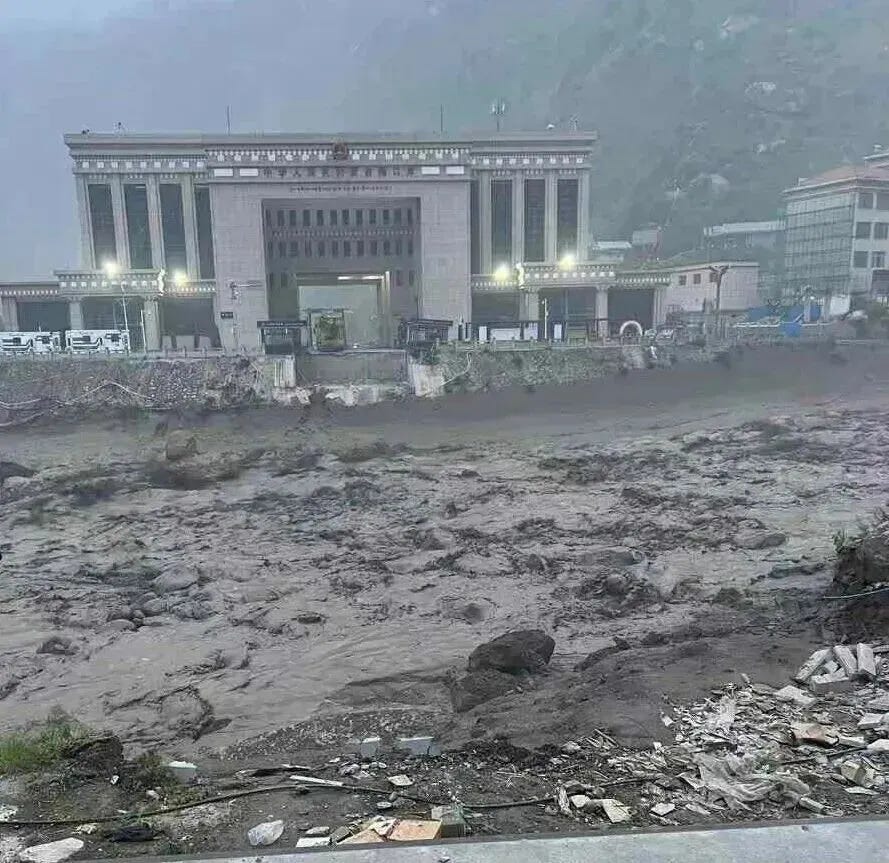
(July 2025: floodwaters destroy the China–Nepal Friendship Bridge at Gyirong Port)
As early as 2018, publicly available Chinese-language sources had already described, in plain terms, the risk chain forming across Tibet: a warming climate accelerates glacial melt; the ice thins and loses its former stability; glacial lakes expand in turn; ice avalanches, glacial-lake outburst floods, debris flows, and mountain torrents can link into a chain, carrying a change that begins deep in the high mountains to places tens or even hundreds of kilometers away.
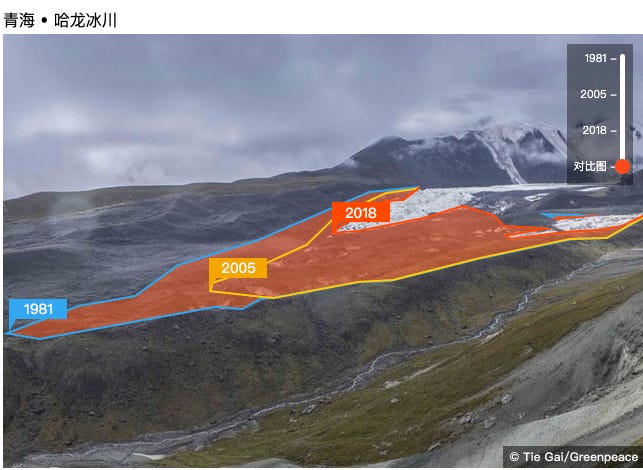
(Glaciers retreating year by year. Source: Greenpeace)
The CCP is not unaware of these risks. Over the past decade, one disaster after another has turned the warnings into reality.
In 2016, two glaciers in the Aru range of Ngari collapsed wholesale within two months of each other; the massive flows of ice and snow killed nine people. In 2018, roughly 130 million cubic meters of glacier and debris broke away at Sedongpu in Nyingchi, damming the Yarlung Tsangpo for about 60 hours, raising upstream water levels by some 75 meters, inundating roads and power facilities, and forcing at least 6,000 residents to evacuate. Sedongpu has since seen repeated ice-rock avalanches, debris flows, and river blockages, including in 2021 and 2022.
In 2020, the Jinwuco glacial lake in Lhari County, Nagchu, burst its banks. Some 10 million cubic meters of floodwater surged downstream, severely damaging roads, bridges, and buildings along the river. The research on that event concluded not only that continued glacial retreat had created the conditions for the disaster chain — it stated explicitly that the ever-growing infrastructure inside the floodplain further amplified the consequences. In other words, development may not create the initial natural event, but it can determine whether that event ends as a human catastrophe.
A risk report on the China–Nepal transport corridor, released by the Institute of Mountain Hazards and Environment of the Chinese Academy of Sciences in Chengdu on August 26 of this year — the very day of the disaster — shows more than 700 debris-flow gullies distributed along the corridor, with the highest-hazard zones concentrated precisely in the Gyirong Tsangpo basin in southern Gyirong County. The report notes that fractured rock, enormous vertical relief, glaciers and glacial lakes — combined with the extreme heat, intense rainfall, and increased meltwater brought by climate change — together create the conditions for frequent debris flows.
The irony is that the same report calls this transport line a “golden corridor” for Tibetan tourism and a key zone of the western development strategy.
On one side, high-hazard river valleys; on the other, a “golden corridor.” On one side, ever more unstable glaciers and mountainsides; on the other, roads, logistics, and a national strategy that must keep pressing forward.
This contradiction is no accident. It is a political task assigned by Beijing.
In April 2026, the authorities announced that 624 border “moderately prosperous” (xiaokang) villages had been completed, and laid out plans to keep building a so-called “border town-and-village corridor belt” anchored on border county seats (including Gyirong County, where this disaster struck), key ports (including Gyirong Port), and towns — while praising the practice of implanting into border life the notion that “everyone is a sentry, every household a sentry post, every village a fortress.” In the official narrative, these projects are invariably tied to “guarding the territory and securing the border,” to “national security,” and to tightened border control. The next-phase development plan published at the end of 2025 still calls for expanding the integrated transport network, strengthening port logistics nodes, and continuing to build the Shigatse–Gyirong land-border-port national logistics hub, tying it all to the Belt and Road strategy.
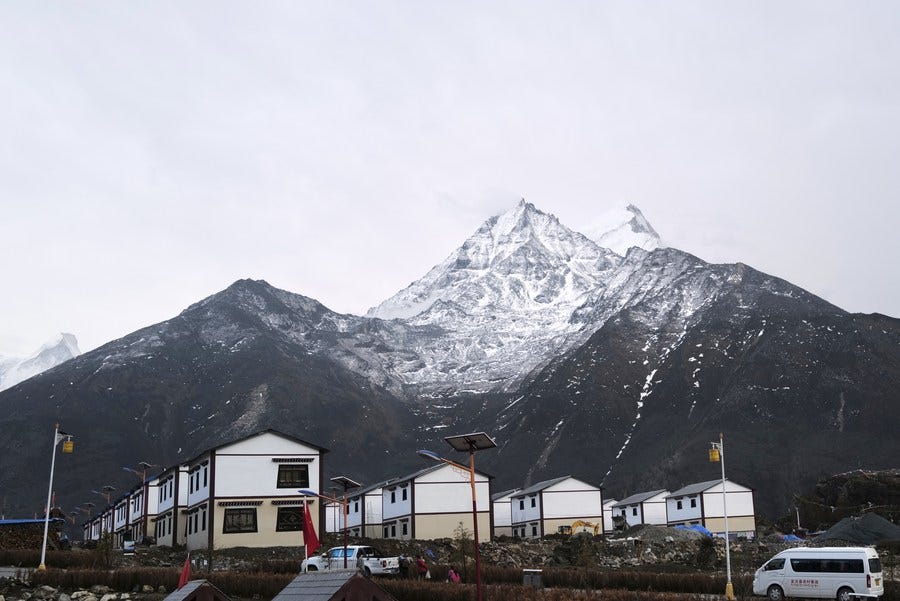
(A xiaokang village built by the CCP in Rongxar Township, Tingri County. The uniform rows of houses look like army barracks — and every one of them sits beneath snow peaks and glaciers)
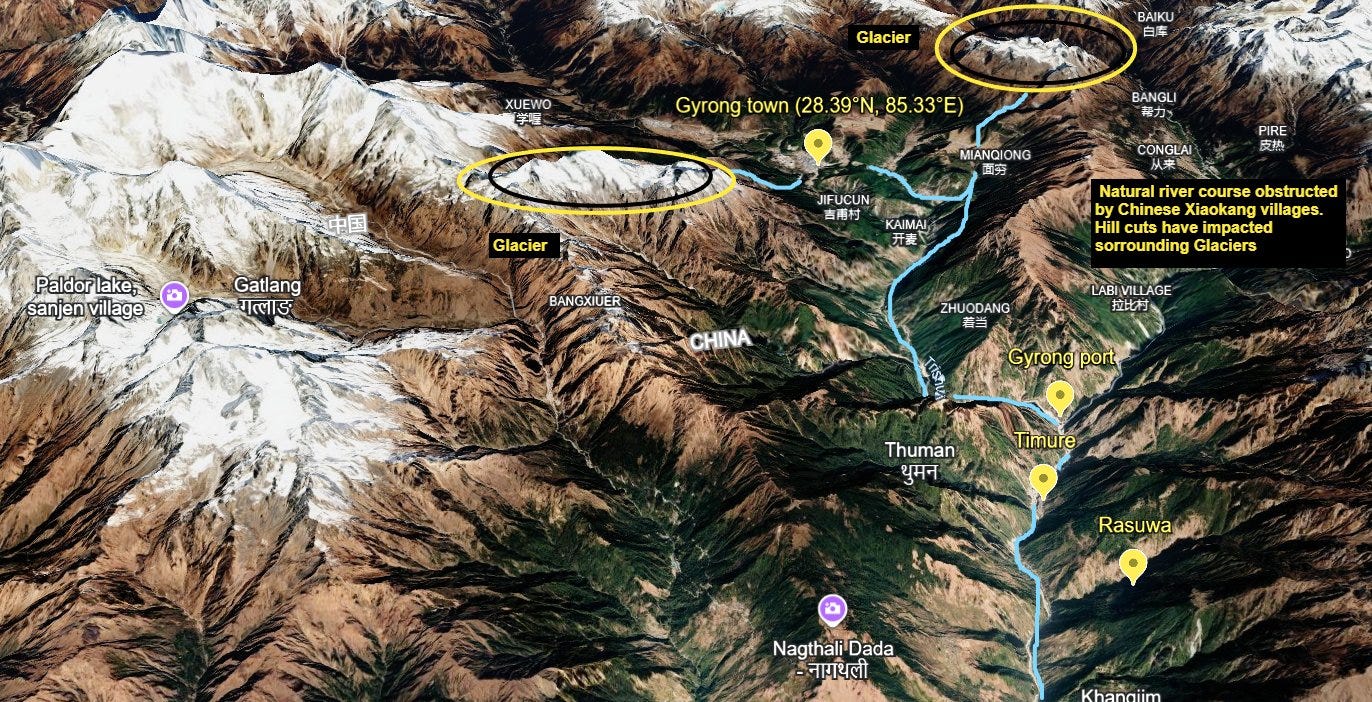
(Nepal Correspondence reports blamed China’s border settlements and massive construction for this ecological disaster)
A family is treated as a sentry post, a village as a fortress, and Tibetans’ homes and livelihoods have been conscripted into the border-guarding system. Under this arrangement, population becomes a resource to be deployed, and the homeland becomes a stronghold to be fortified. Tibetans are forced to leave their homes, give up their traditional nomadic and farming life, and move into uniformly planned settlements; with their livelihoods gone, their future depends entirely on the state’s arrangements. Such settlements are not merely about one family’s life — they serve as a showcase of the state’s capacity for control.
Holding up this border-guarding system is also a cohort of ordinary young people from the Chinese interior who tested their way out of their hometowns, exam after exam, and ended up as civil servants at border ports. Among the missing at Gyirong Port is a 24-year-old woman named Li Leiyang. She came from a village in northern Anhui and climbed her way up: from a vocational college into a bachelor’s degree, then into a master’s program at China Agricultural University — one of the elite “985” schools — and after graduation into the customs service, working in plant quarantine. Just days after taking up her post, she went missing in the August 26 mudslide. Hers is the path so many people know as that of the “small-town test-taker”: study, test, study again, test again, and finally win a stable job. But getting into the system does not mean holding power, nor does it mean truly understanding the natural and human world of the frontier where one is posted. A rank-and-file officer cannot decide where a port is built, still less how many people a national strategy should expose to risk. The uniform is on her body, but the power to decide rests with people far away — people who never once considered that the frontier these young people had rooted themselves in is a melting snowland plateau, and that the mountains and rivers they pillow their heads on trace a borderline that Tibetans risk their lives to cross.
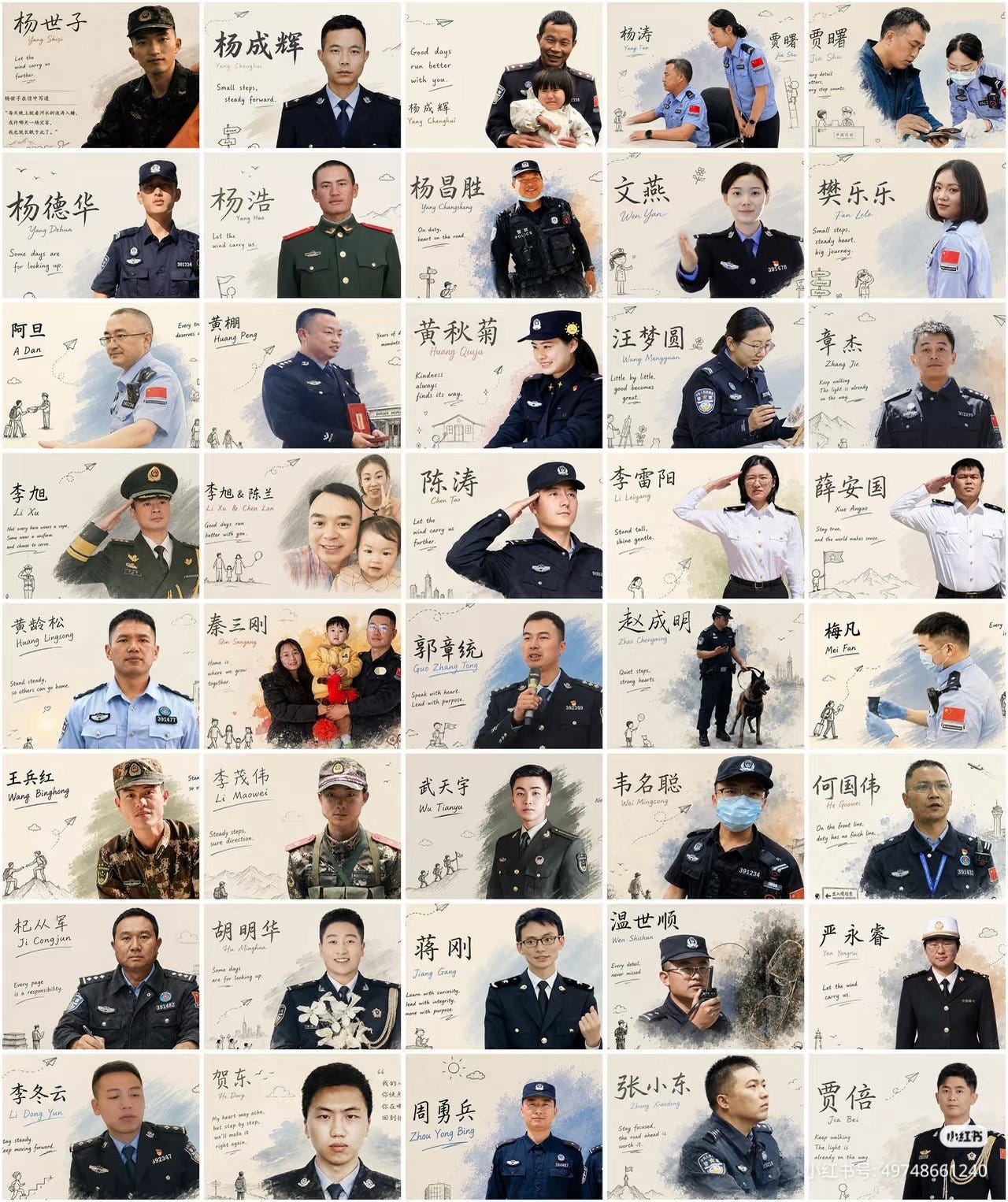
On the empire’s frontier, the Tibetans who have lived here for generations are moved into settlements to “guard the territory and secure the border,” while young people who tested their way up from ordinary families are called on to shed their blood. When national strategy lands on their heads, it takes the form of a specific post, a specific dwelling — and, in the end, of calamity. The usurpers of the nation sit safely in their halls of power, deploying other people’s endurance, extolling other people’s sacrifice, and entering other people’s suffering into their own book of merit.
In the CCP’s logic of governing Tibet, “development,” “border consolidation,” transport corridors, and energy bases are, as a rule, political goals fixed in advance. The ecological environment and disaster risk are demoted to technical problems — to be dealt with, once the goals are set, by sensors, floodwalls, slope reinforcement, dredging, and rescue teams. So the government first decides that this place must be built up, and only then studies how to protect everything already built. The question it asks is never “should people and infrastructure keep being concentrated here at all?” but “since we must build, how much more engineering do we need to add?”
Before the grand national strategy, individual lives count for nothing: the people’s lives may serve as the price of achieving the state’s goals, but never as a reason to call those goals off.
That is precisely why responsibility must be stated plainly. Tibet’s development certainly requires roads, electricity, hospitals, schools, and safer housing. But here, livelihood projects have been bound to the political tasks of national security — what gets built, where, and at what scale answers, more often than not, to political logic rather than to residents’ needs or ecological sense. Since the government claims ports, highways, border villages, and relocation settlements as its achievements, it must also answer for their siting, their scale, and the secondary disasters they set in motion.
And truly responsible development must begin with an admission: the snowland plateau is not a blank map waiting for Beijing to fill in with railways, highways, hydropower stations, ports, and “modernized villages.” The mountains, rivers, and glaciers here have measures of their own — and climate change is now altering those very measures. Responsible development is not just a matter of building sturdier works. It means acknowledging that some places should not be built on at all, that some roads must be rerouted, that some villages must be left to decide for themselves whether to relocate — and that some national strategies and development goals are simply not worth completing at the cost of human lives.
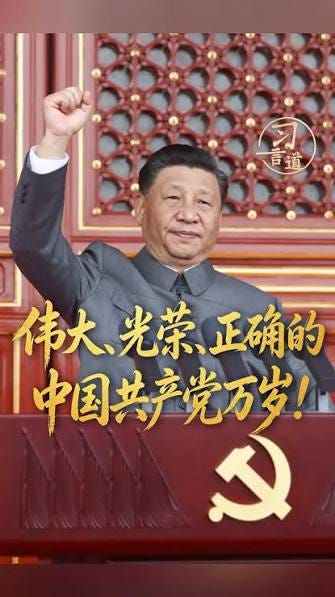
In reality, however, the political gains of these projects go to the state and to the Party, and the resource gains go to the interior. When a project is completed, the state needs Tibetans to thank the Party for developing Tibet; when the project is washed away, the state needs Tibetans to thank the Party for the rescue. Whatever happens, the Party is glorious, great, and correct. But when the glaciers retreat, the rivers change course, and the mountains begin to move, those who pay the final price are still the Tibetans who live on this land — and the ordinary, striving people far from the centers of power, people like Yang Shizi and Li Leiyang.
文:Yuqiao Hu Editor:Ginger Duan
Documentary Recommend:《Snow-mountain Monitor》豆盖加 |山水自然保护中心